Alzheimer’s Disease and Neurofibrillary Tangles:
One of the most common neurodegenerative diseases, Alzheimer’s Disease (AD), is a form of dementia characterized by two hallmarks: amyloid-β plaques and neurofibrillary tangles (NFTs). An important discovery has been made linking insulin resistance to the formation of these hallmarks. The activation or inactivation of key molecules in the insulin signaling pathway, such as PI3K, Akt, GSK-3β, and mTOR, can either increase or decrease phosphorylation. Modulation in phosphorylation creates insulin signaling deficiencies, leading to what is known as “brain insulin resistance”. When insulin signaling in the brain is dysfunctional, AD symptoms are accelerated, and the formation of amyloid-β plaques and NFTs is promoted.[1] To read more about the connection between “brain insulin resistance” and Alzheimer’s Disease click here.
Understanding these AD hallmarks is essential for better diagnosis and treatment techniques. In this post, we will explore the formation, structure, and importance of neurofibrillary tangles.
The Formation and Structure of NFTs:
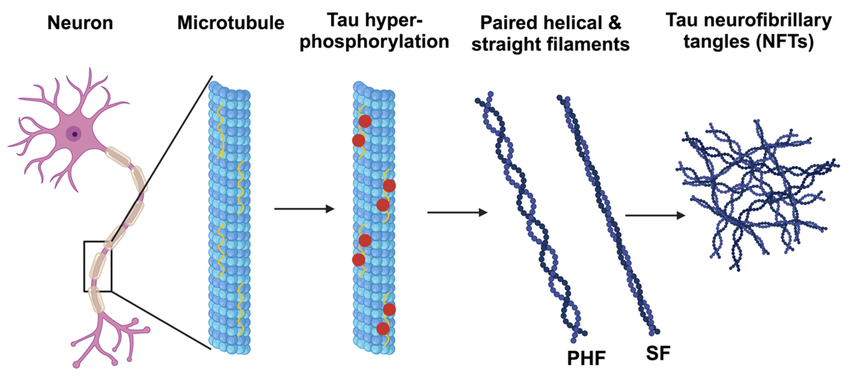
To begin, it is important to note that tau proteins play an essential role in stabilizing microtubules in the brain. The formation of NFTs begins when hyperphosphorylated tau proteins detach from these microtubules. Without the adherence to microtubules, tau proteins misfold and twist into paired helical filaments, which then accumulate inside the neuronal cell body. These paired helical filaments eventually condense into the large, dense masses known as NFTs.[2] This process is further outlined in the image below.[3]
The Spreading of NFTs:
A significant aspect of NFTs is how they spread throughout the brain. They use a prion-like mechanism, in which misfolded tau proteins induce the surrounding functional tau proteins to adopt their misshapen conformation. Along with this rapid spreading mechanism, NFTs remain even after the host neuron dies. These tangles remain behind as extracellular remnants, contributing to ongoing neurodegeneration.[4]
The Maturity Levels of NFTs:
NFTs develop through three progressive stages:
- Pretangles
- Diffuse cytoplasmic tau staining
- Perinuclear tau accumulation (surrounding the nucleus)
This is the earliest stage, where tau buildup begins, but dense bundles have not yet formed.
- Mature Tangles
- Densely packed bundles
- Nuclear shrinking
At this stage, the tangles have fully formed, disrupting cellular function.
- Ghost Tangles
- Extracellular remnants
- Loosely arranged bundles without a nucleus
These remain after the host neuron has died and act as a lasting marker of damage outside of the cell. [5]
Why NFTs Matter:
Understanding NFTs is critical because they represent both a mechanism of cell degradation and a measure of disease progression. By targeting tau misfolding, aggregation, or spread, researchers hope to slow or halt neurodegeneration, serving as a promising therapeutic target for Alzheimer’s Disease.
[1] Ansab Akhtar and Sangeeta Pilkhwal Sah, “Insulin Signaling Pathway and Related Molecules: Role in Neurodegeneration and Alzheimer’s Disease,” Neurochemistry International 135 (May 2020): 104707, https://doi.org/10.1016/j.neuint.2020.104707.
[2] “What Are Neurofibrillary Tangles and How Do They Form?,” ScienceInsights, November 27, 2025, https://scienceinsights.org/what-are-neurofibrillary-tangles-and-how-do-they-form/.
[3] “Hyperphosphorylation of Tau Protein. Hyperphosphorylation of the Tau…,” ResearchGate, accessed February 10, 2026, https://www.researchgate.net/figure/Hyperphosphorylation-of-tau-protein-Hyperphosphorylation-of-the-tau-protein-causes-the_fig1_376735971.
[4] ScienceInsights, “What Are Neurofibrillary Tangles and How Do They Form?”
[5] Christina M. Moloney et al., “The Neurofibrillary Tangle Maturity Scale: A Novel Framework for Tangle Pathology Evaluation in Alzheimer’s Disease,” bioRxiv, June 6, 2025, 2025.06.02.657435, https://doi.org/10.1101/2025.06.02.657435.
