
Alzheimer’s is a brain disorder that slowly damages memory and thinking. An affected brain has Amyloid-beta plaques that build up between brain cells as well as Tau tangles inside the cells.
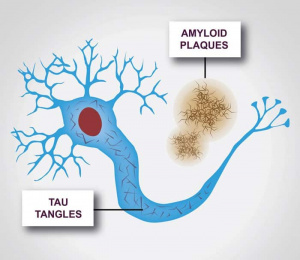
These changes in the brain disrupt communication between neurons and can ultimately lead to their death, contributing to memory loss. [1]
According to the Alzheimer’s association, over 7 million Americans are living with Alzheimer’s disease with that number being expected to rise to 13 million in the next 25 years. [2]
This picture was sourced from Alzheimers Research UK
For more information about Alzheimer’s affects click here
Treatments of Alzheimer’s Disease in the past:
Aduhelm, a drug that was approved for a short time in 2021, showed that removing the beta-amyloid plaques was able to reduce cognitive decline. [3] It was the only new drug that was approved for the treatment of Alzheimer’s since 2003. [4]
Most approved drugs target symptoms not stopping disease progression. Stopping the disease progression is the huge hurdle in Alzheimer’s research. This is mostly due to late initiation of treatments and incorrect targets for treatment. Additionally, there is a wide gap in knowledge of the complexities involved in the pathophysiology of this disease. [4].
Scientists can’t just fix a single spot. They would have to rebalance an entire network of cellular communication. Inside brain cells are protective signaling systems, including pathways known as PI3K and Akt. These pathways help cells survive, repair damage, and regulate important processes. When they stop working properly, the neurons become more vulnerable thus contributing to plaque buildup and eventually cell death. Trying to adjust these pathways without disrupting other functions is extremely complex. [5] Additionally, the complexities of this disease would require a combination of treatments [4].
But what if Alzheimer’s isn’t just about plaques- but about how brain cells process energy?
What the future may hold:
The future of Alzheimer’s treatment may not rely on removing plaques in the brain. Instead, the focus may be on the restoration of the insulin pathways.
Is Alzheimer’s Type 3 Diabetes?
Brain cells need glucose to function, and insulin helps the cells in our brains use that energy. In a brain affected by Alzheimer’s, the cells become Insulin resistant like in type two diabetes. Because of this, some scientists have begun referring to Alzheimer’s as Type 3 diabetes.
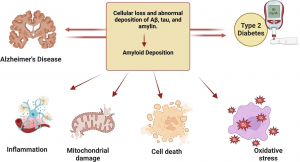
This inability to properly use glucose causes a struggle for cells to produce the energy needed to communicate. This energy failure is what can cause the PI3K and Akt pathways to stop functioning properly. [5]
This image was sourced from News Medical & Life Sciences
This shift in understanding has opened new possibilities for treatment. Now, researchers are exploring therapies that improve insulin signaling and restore the brains’ ability to use energy effectively.
One medication that researchers are exploring is Metformin, a drug commonly prescribed for type 2 diabetes. Metformin improves the body’s sensitivity to insulin and is being investigated to support the brains’ ability to use glucose efficiently. [6]
Alzheimer’s disease research has long been focused on amyloid plaques and tau tangles, and many treatments have been focused on removing these proteins. But targeting plaques alone has not been enough to stop the progression of the disease suggesting deeper disruptions, such as impaired insulin signaling, are also involved. Therefore, the future of Alzheimer’s treatment may depend on restoring the brains energy balance, protecting pathways like PI3k and Akt and combining multiple therapies rather than relying on a single target.
-
Alzheimer’s disease fact sheet. (2023, April 5). National Institute on Aging. https://www.nia.nih.gov/health/alzheimers-and-dementia/alzheimers-disease-fact-sheet
-
Alzheimer’s disease facts and figures. (n.d.). Alzheimer’s Association. Retrieved February 18, 2026, from https://www.alz.org/alzheimers-dementia/facts-figures
-
Aducanumab to be discontinued as alzheimer’s treatment | alz. Org. (n.d.). Alzheimer’s Association. Retrieved February 18, 2026, from https://www.alz.org/alzheimers-dementia/treatments/aducanumab
-
Yiannopoulou, K. G., Anastasiou, A. I., Zachariou, V., & Pelidou, S.-H. (2019). Reasons for failed trials of disease-modifying treatments for alzheimer disease and their contribution in recent research. Biomedicines, 7(4), 97. https://doi.org/10.3390/biomedicines7040097
-
Akhtar, A., & Sah, S. P. (2020). Insulin signaling pathway and related molecules: Role in neurodegeneration and Alzheimer’s disease. Neurochemistry International, 135, 104707. https://doi.org/10.1016/j.neuint.2020.104707
-
Daly, T., & Imbimbo, B. P. (2025). Long‐term metformin use for Alzheimer’s disease prevention? Alzheimer’s & Dementia, 21(4), e70147. https://doi.org/10.1002/alz.70147ChatGPT was used in the formation of this post
