
Image from Clay Behavior Health Center (https://ccbhc.org/understanding-addiction/)
Psychostimulants Spark Learning Pathways
Your brain learns from experience, remembers what feels good, and craves those behaviors. Every time you eat, socialize, or achieve something, your brain strengthens connections to help you do it again. This learning pathway relies on glutamate, the brain’s main excitatory neurotransmitter, responsible for most communication between neurons. However, the same system that helps you learn healthy behaviors is also influenced by various substances. Therefore, when something overstimulates this system, such as drug use, the brain remembers the feeling and learns it. Psychostimulants, including cocaine, nicotine, and methamphetamine, flood the brain with dopamine [1]. This creates intense feelings of reward and alters glutamate signaling, locking that experience into memory.
How Glutamate Leads to Learning & Memory
Glutamate receptors are essential for how the brain learns and forms memories because they control how strongly neurons communicate and form synapses. NMDA receptors initiate long-term changes in the brain by allowing calcium into cells, triggering processes needed for learning. AMPA receptors strengthen these connections by increasing fast signaling between neurons, making memories more stable. Kainate receptors help regulate overall brain activity, supporting this communication. Metabotropic receptors (mGluRs) play more specific roles in this system, and are divided into 3 main groups. Group I mGluRs enhance signaling and modulate excitatory signaling, strengthening learning pathways. Group II mGluRs are important for the reward system, and regulate neurotransmitter release. Group III mGluRs act as brakes by suppressing glutamate release and preventing overstimulation [1]. Together these receptors balance strengthening and controlling brain signals, allowing normal learning and memory to occur. But when this normal balance is disrupted by psychostimulant use, it leads to overly strong and persistent memories like those seen in addiction.
| Receptor | What It Normally Does | What Happens in Addiction |
|---|---|---|
| NMDA | Helps with learning & memory | Strengthens drug-related memories |
| AMPA | Sends fast brain signals | Boosts cravings & drug sensitivity |
| Kainate | Helps control brain activity | Supports excitation in addiction |
| Group I (mGluR1, 5) | Boosts brain signaling and learning | Increases drug-seeking & relapse |
| Group II (mGluR2, 3) | Reduces glutamate release | Decreases cravings & relapse |
| Group III (mGluR4,6,7,8) | Slows down brain signaling | Control addiction signals |
Table 1: This table shows how different glutamate receptors effect addiction, either by strengthening behaviors or helping regulate and reducing drug-seeking behavior [1].
Helpful Organizers: Homer Proteins
Within your brain, there are scaffolding proteins called Homer proteins that help organize communication between receptors [1]. In the glutamate pathway, Homer proteins regulate group I mGluR signaling to help with excitatory neurotransmission and synaptic plasticity [2], the process in the brain that results in learning and memory. They help with structure and keeping signaling systems stable and efficient. By controlling glutamate signaling, Homer proteins indirectly influence dopamine reward pathways as well [4]. Therefore, they are important in the signaling that effects learning and feelings of reward.
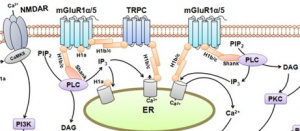
Figure 1: Long-form Homer proteins (peach rectangles, “H1b/c”) stabilize mGluR signaling by linking receptors to intracellular calcium pathways, while short-form Homer proteins (peach circles, “H1a”) disrupt this scaffolding, altering signaling and promoting synaptic changes [5].
Rewiring the Brain & Relapse
Synaptic plasticity involves connections between neurons strengthen or weaken over time, altering how we learn and form memories. Processes like long-term potentiation (LTP) and long-term depression (LTD) shape how memories are formed. Drugs disrupt the balance in this process. Instead of normal learning, they exaggerate certain pathways, particularly those tied to reward. Chronic psychostimulant use increases a type of homer protein, Homer1a, which disrupts the normal scaffolding with mGluR receptors and makes glutamate signaling unstable [3].
Therefore, use of psychostimulants causes glutamate levels and synaptic connections to change, allowing the brain to undergo drug-induced neuroplasticity. This neuroplasticity causes the memory system to become sensitive to cues related to drug use. Places, feelings, or another memory can trigger intense craving. Drug-seeking is driven by strengthened neural pathways that have been biologically reinforced. Glutamate signaling can increase when exposed to triggers, reactivating the learned pathways and can result in relapse [6].
Conclusion
Addiction involves deep changes in how the brain learns, remembers, and prioritizes behavior. Understanding glutamate signaling and Homer proteins helps identify the root cause and gives researchers new targets for treatment. Therefore, future therapies may focus on helping the brain unlearn harmful patterns. The brain’s adaptability, learning, and memory systems are what allows addiction to be such a strong habit.
- Mozafari, R., Karimi-Haghighi, S., Fattahi, M., Kalivas, P., Haghparast, A. 2022. A review on the role of metabotropic glutamate receptors in neuroplasticity following psychostimulant use disorder. Frontiers in Pharmacology, 124. https://doi.org/10.1016/j.pnpbp.2023.110735
- Shiraishi-Yamaguchi, Y., Furuichi, T. The Homer family proteins. Genome Biol 8, 206 2007. https://doi.org/10.1186/gb-2007-8-2-206
- Niswender, C. M., & Conn, P. J. 2010. Metabotropic glutamate receptors. Annual Review of Pharmacology and Toxicology. 10.1146/annurev.pharmtox.011008.145533
- Szumlinski, K. K., Ary, A. W., & Lominac, K. D. 2008. Homers regulate drug-induced neuroplasticity: implications for addiction. Biochemical pharmacology, 75(1), 112–133. https://doi.org/10.1016/j.bcp.2007.07.031
- Peng Luo, Xia Li, Zhou Fei, Waisang Poon. 2012. Scaffold protein Homer 1: Implications for neurological diseases, Neurochemistry International. Volume 61, Issue 5, Pages 731-738. https://doi.org/10.1016/j.neuint.2012.06.014.
- Ménard, C., & Quirion, R. 2012. Group 1 Metabotropic Glutamate Receptor Function and Its Regulation of Learning and Memory in the Aging Brain. Frontiers in Pharmacology, 3. https://pubmed.ncbi.nlm.nih.gov/23091460/
