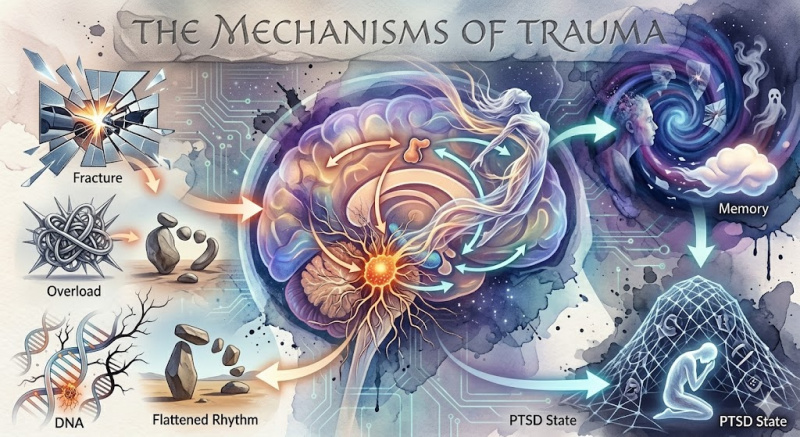
Artstract created by: Eli Hunt through use of Google Gemini
Post-Traumatic Stress Disorder (PTSD) is a debilitating mental health condition caused by experiencing or witnessing a traumatic event. Most people think of PTSD being a condition associated with mostly former military members, while this is a population at risk for
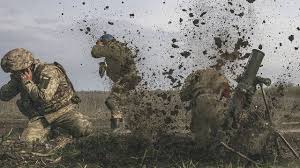
developing PTSD, it can be developed by anyone from any traumatic event, not just war. Some other events that put people at risk of developing PTSD are car accidents, sexual assault, natural disasters or violent crimes. This leads to symptoms that can include nightmares, flashbacks, hypervigilance, negative mood and avoidance of reminders. The mechanisms behind the development of PTSD are unique to other forms of memory development, and these adaptions have contributed to the survival and advancement of humans. To get a better understanding of PTSD and how it affects a person, look here.
Modern day humans, especially those of us who are fortunate enough to live in wealthier societies, are not subject to nearly as much trauma and we live lives more or less free from traumatic stress. When you think of ancient humans, who are subject to predation, dangerous terrain, unknown territory, and other tribes of humans, they were subject to
trauma on a daily basis. The mechanisms behind PTSD work to the benefit of these humans as if they remember where a traumatic event took place or common patterns involved in it, this could help them survive. So as sick as it can be to think of PTSD being a beneficial human adaptation in a modern context, when you wind it back a few thousand years, PTSD has theoretically helped humans to survive into today. To better understand PTSD in this context we need to know how it works.
The Mechanisms Behind PTSD
The place in the brain primarily responsible for memory is the hippocampus. Within the hippocampus are receptors called glucocorticoid receptors. When we are experiencing stress, our bodies release glucocorticoids, which bind to the glucocorticoid receptors. To understand the next part of the pathway we need to back up a little bit and talk about a pair of genes, these genes are called c-Fos and Egr-1. These genes are essentially what tells the hippocampus to prioritize remembering this stimuli, leading to those traumatic memories leaving such a strong impact. These genes are locked behind a hypothetical vault that is unlocked through a histone called H3S10p-K14ac. This key to the vault is something that needs to be made, and glucocorticoid receptors play an essential role to this formation.
The role that glucocorticoid receptors play are small but essential. They act as a scaffold in
the ERK/MAPK pathway that leads to the creation of H3S10p-K14ac. When NMDA receptors activate, allowing a calcium influx to take place in the cell, it leads to the activation of this pathway. In order to create H3S10p-K14ac, ERK needs to activate MSK1/2, which is the kinase that leads to the creation of H3S10p-K14ac. This is where glucocorticoid receptors come in. When glucocorticoid receptors are activated, they act as scaffold between ERK and MSK1/2, allowing for the activation of MSK1/2. MSK1/2 then creates H3S10p-K14ac, which then unlocks the vault containing c-Fos and Egr-1. These genes then create the traumatic memory.
All of this information may be confusing, so lets try looking at it through a historical context. An ancient caveman is out for a hunt when all of a sudden their group gets attacked by a saber-toothed tiger. During the vicious attack, the caveman’s brain releases glucocorticoids
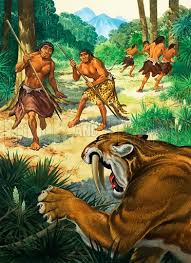
which then bind to the glucocorticoid receptors. As the saber-toothed tiger is roaring at our caveman’s hunting party, the caveman’s brain is creating memories normally through the ERK/MAPK pathway, but the memories aren’t any stronger than normal. Following the activation of glucocorticoid receptors, ERK can activate MSK1/2 and create H3S10p-K14ac. After the saber-toothed tiger sinks it’s teeth into the bounty of their successful hunt, the hunting party is just beginning to fight back. The party successfully fights back against the tiger, and are able to salvage some of their hunt. As our caveman continues to walk back to their cave, H3S10p-K14ac is unlocking the vault containing the c-Fos and Egr-1 gene, and as he is reflecting on the traumatic event, these genes then create the memory and it is engrained stronger than a normal memory.
Next time our caveman is out on a hunt, he is remembering the attack and is hypervigilant for another saber-toothed tiger attack and is prepared to fight back. He also remembers where not to go to lower the chances of encountering a tiger. This allows him and his tribe to survive and the development of a traumatic memory works in their favor. In a modern context, say a car accident, this doesn’t have the same evolutionary advantage. Chances are, someone is very unlikely to experience multiple traumatic car accidents, so having such an engrained memory that leads to behavioral changes does not increase ones odds for survival, rather it just causes them distress. This is how an adaptation that was historically beneficial for survival has backfired in a modern context. All the information here has been simplified and summarized from this article, if you are interested in getting a deeper scientific understanding of PTSD it is a great place to start.
(1) The Economist, The war in Ukraine shows how technology is changing the battlefield, https://www.economist.com/special-report/2023/07/03/the-war-in-ukraine-shows-how-technology-is-changing-the-battlefield
(2) Look and Learn, Saber-Toothed Tiger Attack Image, https://www.lookandlearn.com/history-images/A829569/Sabre-tooth-tiger-attacking-Homoerectus
Primary Source: Reul J. M. (2014). Making memories of stressful events: a journey along epigenetic, gene transcription, and signaling pathways. Frontiers in psychiatry, 5, 5. https://doi.org/10.3389/fpsyt.2014.00005
