Imagine scanning a barcode at the grocery store. That pattern of lines tells the scanner exactly what the product is, how much it costs, and where it came from. Now imagine your brain doing something similar, using tiny chemical “barcodes” to decide how cells respond to various signals like cannabis, stress, or pain. Researchers have found that receptors in the brain use a system called phosphorylation barcoding to control how signals are processed. Understanding this hidden barcode system in cannabinoid receptors could change how we think about cannabis, brain signaling, and future medical treatments.
The Endocannabinoid System
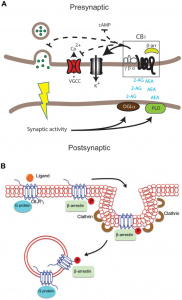
Your brain has a unique signaling system called the endocannabinoid system (ECS). This system helps keep brain activity in balance in plays a major role in memory, mood, pain, and neuroplasticity. It works through cannabinoid receptors, especially CB1 receptors, which are some of the most abundant receptors in the brain. When neurons become active, they release endocannabinoids, mainly anandamide (AEA) and 2-arachinonoglycerol (2-AG). These molecules travel backward across the synapse and bind to CB1 receptors on the presynaptic neuron. The backward signaling reduces neurotransmitter release, acting like a brake that prevents neurons from becoming overactive.
CB1 receptors are a type of GPCR, which means they translate chemical signals into cell responses. When activated, they typically use G proteins for signaling, but they can also be phosphorylated and recruit other proteins, which leads to long term changes in brain function. Since CB1 receptors are so widespread, the ECS in involved in many neurological conditions like epilepsy, neurodegeneration, traumatic brain injury, and psychiatric disorders [1].
The Creation of Brain “Barcodes”
Neurons communicate using receptors on their surface. One of the largest and most important receptor families is called G protein-coupled receptors (GPCRs). These receptors detect neurotransmitters, hormones, and drugs and turn those signals into actions inside of the cell. GPCRs act as decision making sites, rather than simple on/off switches. When a GPCR is activated, enzymes called G-protein coupled receptor kinases (GRKs) add small chemical tags called phosphate groups to the receptor. Instead of just one tag, multiple spots can be tagged in different combinations. This pattern is known as the phosphorylation barcode. These barcodes are read by proteins called β-arrestins, which decide what happens next [2]. Some barcodes shut the receptor down, some pull it into the cell, and others activate new signaling pathways that can change how the neuron acts. Different molecules can create different barcodes on the same receptor, this means that the same receptor can send different messages depending on what binds to it, this is called biased signaling [3].
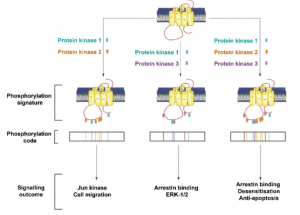
In the ECS, phosphorylation barcoding allows CB1 receptors to fine tune how cannabinoid signals are processed. Different phosphorylation patterns on CB1 receptors influence whether signaling continues at the cell surface or shifts to other pathways inside the neuron. These differences help explain how cannabinoid signaling can produce both rapid changes in neurotransmission and longer-term effects on brain function [2]. Different phosphorylation barcodes at CB1 receptors can lead to changes in gene expression and protein synthesis [1]. Also, barcodes explain why THC and cannabis affect people in different ways, since individuals and brain regions can generate distinct phosphorylation patterns in response to the same drug [5].
Why This Matters for the Public and Brain Health
Understanding phosphorylation barcoding in the ECS could help scientists develop better cannabinoid based treatments. Since cannabinoid receptors can send different messages based on their “barcode”, researchers may be able to design drugs that keep the helpful effects of cannabinoids, like pain relief and calming cells, while reducing unwanted side effects like memory problems or dependence. This could improve treatment for conditions such as chronic pain, epilepsy, neurodegenerative diseases, and mental health disorders.
To learn more about how endocannabinoids and cannabis are being studied as medical treatments, click here.
References
[1] D. A. Kendall and G. A. Yudowski, “Cannabinoid Receptors in the Central Nervous System: Their Signaling and Roles in Disease,” Frontiers in Cellular Neuroscience, vol. 10, no. 294, Jan. 2017, doi: https://doi.org/10.3389/fncel.2016.00294.
[2] N. R. Latorraca et al., “How GPCR Phosphorylation Patterns Orchestrate Arrestin-Mediated Signaling,” Cell, vol. 183, no. 7, pp. 1813-1825.e18, Dec. 2020, doi: https://doi.org/10.1016/j.cell.2020.11.014.
[3] S. B. Liggett, “Phosphorylation Barcoding as a Mechanism of Directing GPCR Signaling,” Science Signaling, vol. 4, no. 185, pp. pe36–pe36, Aug. 2011, doi: https://doi.org/10.1126/scisignal.2002331.
[4] H. Chen, S. Zhang, X. Zhang, and H. Liu, “QR code model: a new possibility for GPCR phosphorylation recognition,” Cell Communication and Signaling, vol. 20, no. 1, Mar. 2022, doi: https://doi.org/10.1186/s12964-022-00832-4.
[5] M. S. Ibsen, D. B. Finlay, M. Patel, J. A. Javitch, M. Glass, and N. L. Grimsey, “Cannabinoid CB1 and CB2 Receptor-Mediated Arrestin Translocation: Species, Subtype, and Agonist-Dependence,” Frontiers in Pharmacology, vol. 10, Apr. 2019, doi: https://doi.org/10.3389/fphar.2019.00350.
Featured image was created by Julia Wolf and Microsoft CoPilot
