
Feature Image from Pexels
Our relationship with food intake and satiety is a complex system in the brain. Appetite is tightly regulated by a network of signals in the hypothalamus, which plays a large role in energy balance. When inflamed, the balance between food intake and energy expenditure is disrupted.[1]
Hypothalamic Inflammation:
The article linked here highlights that hypothalamic inflammation often develops in response to chronic exposure to high-fat and high-calorie diets. This inflammation interferes with how the brain processes signals related to hunger and fullness. Under normal conditions, hormones like leptin and insulin tell the hypothalamus when the body has enough energy stored. However, when inflammation is present, neurons become less responsive to these signals. This creates leptin or insulin resistance, resulting in the brain failing to recognize satiety. In turn, individuals may continue to feel hungry even when they have sufficient energy stored. Thus, hypothalamic inflammation is a pivotal component of metabolic disorders and obesity.[2]
Role of the Endocannabinoid System:
This imbalance also allows other systems to have a stronger influence on eating behavior. One of these is the endocannabinoid system. Rather than simply increasing appetite, cannabinoids act directly on hypothalamic circuits to reshape how hunger signals are produced and interpreted.
In the arcuate nucleus, cannabinoids promote food intake through two major mechanisms. They increase the release of neuropeptide Y (NPY), a strong appetite-stimulating signal, and they alter the function of POMC neurons. Normally, these neurons help suppress appetite by releasing α-MSH. However, when cannabinoids are present, they release β-endorphin instead, which promotes feeding through opioid signaling.[3] This is shows how cannabinoids don’t just amplify hunger, but alter the function of key neurons entirely.
This effect extends across multiple hypothalamic regions. In the paraventricular hypothalamus, cannabinoid signaling shifts the balance of neurotransmitters by increasing GABA, which stimulates eating, and decreasing serotonin, which promotes fullness. This region also works closely with ghrelin, a hormone that drives hunger and depends on the endocannabinoid system to function. In the lateral hypothalamus, cannabinoids excite neurons that release orexin and melanin-concentrating hormone, both of which increase motivation to seek out food and promote impulsive eating.[4]
These effects explained above are visualized here.
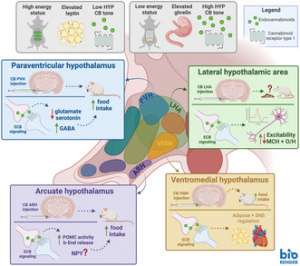
Source of Image: Hypothalamic cannabinoid signaling: Consequences for eating behavior – PMC
These biological mechanisms are exemplified when thinking about the use of cannabis, specifically THC, which is known to increase cravings, especially for high-fat, high-calorie foods. Interestingly, edible forms tend to produce a stronger and longer-lasting increase in appetite compared to inhaled forms, possibly because of prolonged effects on hunger-related hormones like ghrelin.[5]
Effect on Obesity:
The relationship between cannabis and body weight is not as straightforward as it might seem. Despite increased appetite, cannabis use alone is not strongly linked to weight gain and has even been associated with lower BMI, though this is not a causal relationship. However, when use becomes disordered, there is a greater risk of losing control over eating behaviors, and it may co-occur with eating disorders. Indirect factors, such as reduced physical activity, can also influence long-term outcomes associated with cannabinoid use.[6]
Final Thoughts:
Overall, appetite is not controlled by a single pathway but by a complex system. Hypothalamic inflammation can alter normal regulatory signals, and within that altered environment, the endocannabinoid system can significantly amplify hunger. Together, these processes show how deeply brain chemistry shapes something as mundane as eating.
[1] Alexander Jais and Jens C. Brüning, “Hypothalamic Inflammation in Obesity and Metabolic Disease,” The Journal of Clinical Investigation 127, no. 1 (2017): 24–32, https://doi.org/10.1172/JCI88878.
[2] Jais and Brüning, “Hypothalamic Inflammation in Obesity and Metabolic Disease.”
[3] Magen N. Lord and Emily E. Noble, “Hypothalamic Cannabinoid Signaling: Consequences for Eating Behavior,” Pharmacology Research & Perspectives 12, no. 5 (2024): e1251, https://doi.org/10.1002/prp2.1251.
[4] Lord and Noble, “Hypothalamic Cannabinoid Signaling.”
[5] Kasey P. S. Goodpaster, “Cannabis, Weight, and Weight-Related Behaviors,” Current Obesity Reports 14, no. 1 (2025): 40, https://doi.org/10.1007/s13679-025-00633-z.
[6] Goodpaster, “Cannabis, Weight, and Weight-Related Behaviors.”
