The Brain’s Endocannabinoid System
The brain is constantly sending an receiving signals that keep our whole body functioning properly, but it needs help staying regulated. One main system in that brain that helps with regulation is one that many people have never heard of before, the endocannabinoid system (ECS).
The ECS is a network that helps regulate neurotransmitter release and neuronal signaling. When neurons become too active, the cell can produce molecules called endocannabinoids. These molecules activate CB1 receptors, which slow the release of neurotransmitters. The main two neurotransmitters it regulates are glutamate and GABA, with the goal of equilibrium of their levels [2].
- If the neuron is releasing too much glutamate (an excitatory neurotransmitter, increasing activity), CB1 activation reduces that release. This is called depolarization-induced suppression of excitation.
- If the neuron is releasing too much GABA (an inhibitory neurotransmitter, relaxing activity), CB1 can reduce its release as well. This is called depolarization-induced suppression of inhibition.
More about the ESC can be found here: https://www.frontiersin.org/journals/cellular-neuroscience/articles/10.3389/fncel.2016.00294/full
Triggering Seizures- The Problem
Epilepsy is a condition commonly characterized by seizures. Seizures are bursts of abnormal electrical activity in the brain, typically caused by an imbalance between excitatory and inhibitory neurotransmitters (figure 1) in the brain can cause these unstable electrical surges. When excitation is occurring significantly more than inhibition, increased activity causes neuron to fire uncontrollably, triggering a seizure. These can occur more often when the ESC can’t stabilize balance (figure 2), which happens most often in people with low amounts of CB1 receptors, or endocannabinoid levels and enzymes that produce and break down these molecules are abnormal[3].
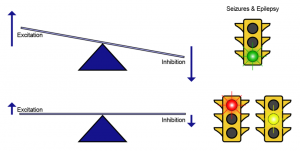 Figure 1: Here is a helpful visual of how balance in the brain determines seizures. When unbalanced, impulses in the brain receive a “green light,” leading to abnormal bursts of electricity, causing the seizure [1].
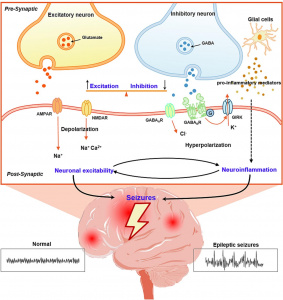
Figure 2: This diagram shows the imbalance between excitatory and inhibitory neurotransmission and how it contributes to seizure activation. Excitatory neurons release glutamate, increasing neuronal excitability. Inhibitory neurons release GABA, reducing excitability [4].
Therapeutic THC- A Solution?
THC is the primary psychoactive compound in cannabis, which partially activates the CB1 receptors, meaning it can bind to the same receptors used by the brain’s own endocannabinoids and activate them[3]. Since CB1 activation reduces glutamate release, THC can reduce neuronal over excitability, helping to control seizures[2]. Therefore, THC can function as an anticonvulsant by:
-
Reducing excitatory glutamate signaling
-
Enhancing inhibitory GABA pathways
-
Regulating ion channels that control neuronal firing
These mechanisms can lower seizure frequency or intensity in some individuals. THC also comes with psychoactive risks. At high doses, especially containing more than 15% THC, risks outweigh potential therapeutic benefits [5]. Side effects can include anxiety, cognitive impairment, and increased risk of dependence. Researchers are still working to determine the optimal THC dose, concentration, and cannabinoid combination to maximize anti-seizure effects while minimizing unwanted psychoactive outcomes[6].
This video has some additional information on THC’s interaction with CB1 receptors: https://youtu.be/ISUXrjBXHsE?si=OAVJVSV78OxVnVV-&t=41
Conclusion
Seizures occur when the balance between excitation and inhibition breaks down. The endocannabinoid system plays a central role in trying to maintain that balance. When it functions properly, it acts by suppressing inhibition or excitation to bring neural firing to equilibrium. Cannabinoids, like THC, activate this system, which can reduce seizure activity. However, dosing, safety, and long-term effects remain active areas of research.
Key Takeaways:
-
Epilepsy involves an imbalance between excitatory (glutamate) and inhibitory (GABA) signaling.
-
The endocannabinoid system regulates the balance of this signaling through CB1 receptors.
-
THC activates CB1 receptors to restore balance and reduce excessive neuronal firing.
-
Cannabinoids can act as anticonvulsants, but high THC concentrations pose psychoactive risks, making dosing important.
-
Ongoing research aims to refine cannabis-based therapies for safer, more effective seizure control.
References
*Featured image/ artstract created by AI.
[1] Devinsky, O., Jones, N. A., Cunningham, M. O., Jayasekera, B. A. P., Devore, S., & Whalley, B. J. 2024. Cannabinoid treatments in epilepsy and seizure disorders. Physiological Reviews, 104(2), 591–649. https://doi.org/10.1152/physrev.00049.2021
[2] Kendall DA and Yudowski GA. 2017. Cannabinoid Receptors in the Central Nervous System: Their Signaling and Roles in Disease. Front. Cell. Neurosci. 10:294. doi: 10.3389/fncel.2016.00294
[4] Chudai Zeng & Chu Chen. 2025. Endocannabinoid signaling in epilepsy, Neurobiology of Disease. Volume 215, 107074, ISSN 0969-9961, https://doi.org/10.1016/j.nbd.2025.107074.
[6] Gómez-Nieto, R., López D. E., Garcia-Cairasco N. 2021. Challenges and Conundrums in Cannabinoid-Based Treatments for Epilepsy Syndromes and Associated Neurobehavioral Comorbidities. Frontiers in Behavioral Neuroscience. Volume 15. https://www.frontiersin.org/journals/behavioral-neuroscience/articles/10.3389/fnbeh.2021.781852