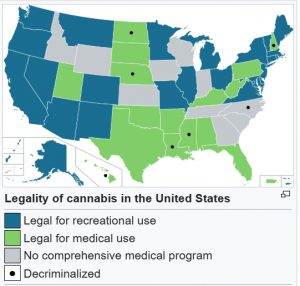
In the last couple decades, feelings about marijuana have changed drastically nationally and internationally. In the USA, forty states have legalized medical marijuana and twenty-four of them have fully legalized it for adults to partake in. Despite this, marijuana remains illegal for recreation and medical use by the federal government. Therefore, marijuana is technically illegal in all fifty states with no medical uses.
A common argument for those that are for legalization of marijuana is that it has lots of health benefits, and up until recently many people thought marijuana was non-addictive or much less addictive than other drugs. So, is there any benefits to marijuana? Well, this is a complex question. Marijuana has multiple compounds that have an effect on your body, the most well known ones are THC and CBD (1). Many of these compounds have been found to effect certain areas of your body in a good way. So the question is not whether marijuana has benefits to it, but what in marijuana can be good for you and how much of an impact do these compounds really have on your health?
How does marijuana affect you?
The endocannabinoid system keeps your central nervous system in check by letting neurons know what to do next. Basically, when a presynaptic neuron releases neurotransmitters these bind to receptors on the postsynaptic neuron and either excite or inhibit the neuron. Following the binding of neurotransmitters is when the endocannabinoid system kicks into gear. The postsynaptic neuron will form endocannabinoids on demand which then act as a neurotransmitter in their own respect. These endocannabinoids travel back to the presynaptic neuron and bind to cannabinoid receptors which starts a chain reaction that leads to depolarization in the neuron which prevents further neurotransmitter release. Basically, it acts as a messenger from the postsynaptic neuron to tell the presynaptic neuron “we’re good, we don’t need anymore neurotransmitters”. This is a simplified version of this article that explains the endocannabinoid system in great detail, so if you are looking for a more in depth explanation this is a great place to start.
As mentioned earlier, marijuana has multiple compounds that can affect you. These compounds are known as cannabinoids. So to understand how marijuana affects you, you must understand what these compounds do individually. The cannabinoids in marijuana that will be discussed are THC, CBD, CBN, and CBC.
THC
The most dominant of these compounds is THC, more specifically Delta-9 THC. This is the main psychoactive compound in marijuana, or in other words, it is the compound that produces the high people experience when they use marijuana. While strains can make the percentage of all these compounds vary extremely widely, typically Delta-9 THC can range from 13-40% of the dry weight of the plant, but the average percentage of illicit marijuana was found to be 27% (2). For more details on how THC rates have changed over the years, check this article out.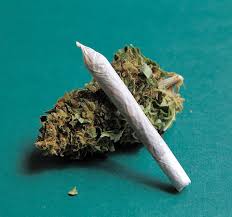
Out of all the compounds in marijuana, this is the most problematic one. For your average person, THC is more harmful than it is good. Regular use can lead to reduced cardiovascular functioning, an increased risk of anxiety and depression, abnormal brain development, and a myriad of other things you don’t want to happen to you (3). For people experiencing extremely debilitating diseases such as Parkinson’s, THC can do wonders. For people experiencing these diseases, the benefits far outweigh the adverse health risks. THC has been found to be a cure for the motor symptoms of Parkinson’s and improved symptoms of tremors, rigidity, pain and sleep problems, but the research into this is extremely limited so do not take this as gospel (4). Currently medical THC is used for managing symptoms of chemotherapy such as nausea, chronic pain relief and muscle spasms. For a more in depth look at THC as a medical treatment, check out this article.
CBD
CBD is probably the second most well known compound of marijuana and it has gotten a great amount of attention in the last decade or so. CBD is non-psychoactive, which is one of the reasons it has gotten so popular. Those who are looking to reap some of the benefits of marijuana but don’t want to get high have turned to various forms of ingesting CBD. The best thing about CBD products is you do not need a prescription to obtain them and they are legal in all fifty states as well as federally.
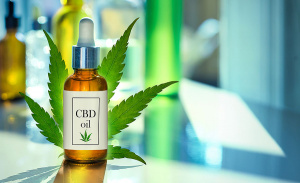
CBD can have benefits for your overall health, giving it potential for use as a supplement. One of its main properties is its anti-inflammatory potential. CBD stimulates the release of anti-inflammatory cytokines which then diminishes the level of pro-inflammatory cytokines. This has made CBD a viable treatment for inflammatory diseases in the intestines, brain and skin (5). Inflammation in your body is beneficial in the short term as that’s how our bodies repair damage and fight disease. But long term inflammation can cause pain and damage to tissues and can increase your risk for neurodegenerative diseases such as Alzheimer’s, Multiple Sclerosis, and Parkinson’s (6). For more information on inflammation look here. For more in depth information and more benefits of CBD check out this article.
CBN
CBN is another cannabinoid in marijuana. This develops from THC as the plant ages and is one of the lesser known cannabinoids by the general public. CBN is another cannabinoid that is legal nationwide and is sold as a supplement either independently or in conjunction with CBD. It is mildly psychoactive, it doesn’t get you high like THC but those who take it report a relaxing or sleepy effect. Therefore, a reason people take CBN is to fall asleep better and to wake up less during the night.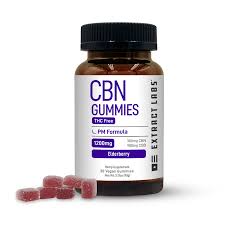
CBN is similar to CBD in the sense that they both have anti-inflammatory properties, but the main advertised use for it is for a sleep medication. This can be very misleading though. Contrary to the other cannabinoids talked about here, there is absolutely zero evidence that CBN provides any benefits to sleep (7). While there is some evidence showing its anti-inflammatory properties, this evidence is very limited. CBN is a lesson in the misleading advertising of cannabinoids with the liberalization of views on marijuana and that many of these companies can claim things that are not true.
CBC
CBC is another lesser known compound in marijuana. Similarly to other cannabinoids, CBC has anti-inflammatory properties. But the thing that makes it special is it’s role in pain relief. Most other cannabinoids bind to cannabinoid receptors know as CB1 and CB2, but CBC has a very weak affinity to both of these, meaning it does not really bind well to either of these receptors. Conversely, CBC has a high affinity for TRPA1 and TRPV1 receptors.
TRPA1 and TRPV1 receptors play a large role in pain perception. When your body experiences a damaging stimuli, say you stub your toe, that release little messengers in your body which bind to both of these receptors. This causes them to activate and send a signal to your brain saying something is wrong, and that signal is what causes us to feel pain. CBC activates both of these receptors, which one would assume causes more pain and not pain relief. But the thing is, when these receptors become activated many times, they become desensitized or become inactivated. So when CBC activates these receptors, they become desensitized or inactivated, leading to a relief in pain (8).
What does all this information mean?
What all this information shows is that marijuana has the potential to be used as a treatment for certain diseases and that the information is quite limited, making its potential unknown. This also means the information on how effective it is and how bad it can be for you is also quite limited. When you consider the current information, your average person doesn’t have much benefit to consuming these compounds. There is much more research to be done into the effects, good and bad, and anything claimed by companies should be taken with a grain of salt. In all, marijuana isn’t going to be a miracle cure or sure fire prevention for diseases, but it won’t do you much harm if you partake every now and again. With anything, approach it with caution and educate yourself before you fully plunge into the world of marijuana.
- Atakan Z. (2012). Cannabis, a complex plant: different compounds and different effects on individuals. Therapeutic advances in psychopharmacology, 2(6), 241–254. https://doi.org/10.1177/2045125312457586
- Vernich, F., Stefani, L., Fiorelli, D., Mineo, F., Pallocci, M., Treglia, M., Marsella, L. T., & Tittarelli, R. (2023). Trends in Illicit Cannabis Potency based on the Analysis of Law Enforcement Seizures in the Southern Area of Rome. Toxics, 11(8), 648. https://doi.org/10.3390/toxics11080648
- Volkow, N. D., Baler, R. D., Compton, W. M., & Weiss, S. R. (2014). Adverse health effects of marijuana use. The New England journal of medicine, 370(23), 2219–2227. https://doi.org/10.1056/NEJMra1402309
- Patel, R. S., Kamil, S., Shah, M. R., Bhimanadham, N. N., & Imran, S. (2019). Pros and cons of marijuana in treatment of Parkinson’s disease. Cureus, 11(6), e4813. https://doi.org/10.7759/cureus.4813
- Leinen, Z. J., Mohan, R., Premadasa, L. S., Acharya, A., Mohan, M., & Byrareddy, S. N. (2023). Therapeutic potential of cannabis: A comprehensive review of current and future applications. Biomedicines, 11(10), 2630. https://doi.org/10.3390/biomedicines11102630\
- Singh, K., Bhushan, B., Chanchal, D. K., Sharma, S. K., Rani, K., Yadav, M. K., Porwal, P., Kumar, S., Sharma, A., Virmani, T., Kumar, G., & Noman, A. A. (2023). Emerging therapeutic potential of cannabidiol (CBD) in neurological disorders: A comprehensive review. Behavioural neurology, 2023, 8825358. https://doi.org/10.1155/2023/8825358
- Maioli, C., Mattoteia, D., Amin, H. I. M., Minassi, A., & Caprioglio, D. (2022). Cannabinol: History, Syntheses, and Biological Profile of the Greatest “Minor” Cannabinoid. Plants (Basel, Switzerland), 11(21), 2896. https://doi.org/10.3390/plants11212896
- Lowin, T., & Straub, R. H. (2015). Cannabinoid-based drugs targeting CB1 and TRPV1, the sympathetic nervous system, and arthritis. Arthritis research & therapy, 17(1), 226. https://doi.org/10.1186/s13075-015-0743-x
Legality of Cannabis by Jurisdiction map is custom made by Wikipedia user –Derived from Blank USA, w territories 2.svg by Heitordp
The photo in THC section retrieved from https://www.henryford.com/blog/2023/01/what-you-should-know-about-marijuana
The photo in the CBD section retrieved from https://www.stbernarddrugs.com/post/whats-the-hype-over-cbd
The photo in the CBN section retrieved from https://www.extractlabs.com/product/cbn-gummies/
Featured image retrieved from https://www.cdc.gov/cannabis/faq/index.html
