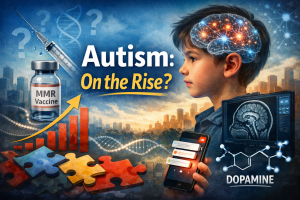
For anyone paying attention to our modern day political atmosphere, it would seem that autism gets mentioned quite regularly. Stemming back from the initial 1998 retracted publication in the Lancet linking MMR vaccines to autism, the disease and its prevalence are used by grifters to foment anti-science narratives among the scientifically uninformed. Despite there being no evidence whatsoever connecting autism with vaccines, the precipitous rise in diagnoses is enough to question what might be causing it – if anything. To do that, we need to talk about the cause of autism.
What is it?
For those unfamiliar with autism and its symptoms, autism is classified as a neurodevelopmental disease, largely impacting communication and behavior. Understood to be genetic in origin, finding what exactly about that origin leads to autism is quite the difficult task, since as of today over 800 genes have been implicated in autism (1). Given this staggering genetic complexity, researchers have increasingly turned to studying the underlying biological systems that these genes influence, hoping to find common threads that might explain how such varied genetic changes produce similar behavioral outcomes. One such system that has garnered significant attention is the dopamine signaling pathway.
Dopamine
For the layperson, dopamine is known as the molecule that makes you feel good when you complete a task, or the molecule that keeps you beholden to your phone and its incessant notifications. The unacquainted will find its structure herein enclosed (2). 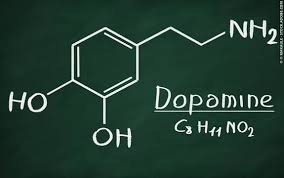 For our purposes, however, dopamine is the neurotransmitter that enforces feelings of motivation and reward. Interestingly, in a review published in 2022, researchers DiCarlo and Wallace investigated the various studies looking at dopamine signaling in autism spectrum disorder (ASD). The authors found that dopamine dysfunction may underlie a distinct subtype of ASD. Brain imaging studies have consistently shown structural and connectivity abnormalities in dopamine-rich regions like the caudate nucleus, and genetic animal models repeatedly demonstrate that ASD-associated mutations disrupt dopamine signaling while simultaneously producing hallmark ASD behaviors (3). Rather than suggesting dopamine is the singular cause of autism, the authors propose it as one of likely several neurobiological subtypes, and argue that identifying individuals with this dopaminergic form of ASD through genetic testing or clinical biomarkers could allow for more targeted, personalized treatment approaches. This conclusion has interesting implications for the question posed earlier. With the prominence of cell phones and iPad kids, is our increased exposure to screens causing dopamine dysfunction? Could this be the cause of the increase in autism throughout the years? Hard to say. To better understand the rise in autism cases, it’s crucial to look at how clinicians diagnose autism.
For our purposes, however, dopamine is the neurotransmitter that enforces feelings of motivation and reward. Interestingly, in a review published in 2022, researchers DiCarlo and Wallace investigated the various studies looking at dopamine signaling in autism spectrum disorder (ASD). The authors found that dopamine dysfunction may underlie a distinct subtype of ASD. Brain imaging studies have consistently shown structural and connectivity abnormalities in dopamine-rich regions like the caudate nucleus, and genetic animal models repeatedly demonstrate that ASD-associated mutations disrupt dopamine signaling while simultaneously producing hallmark ASD behaviors (3). Rather than suggesting dopamine is the singular cause of autism, the authors propose it as one of likely several neurobiological subtypes, and argue that identifying individuals with this dopaminergic form of ASD through genetic testing or clinical biomarkers could allow for more targeted, personalized treatment approaches. This conclusion has interesting implications for the question posed earlier. With the prominence of cell phones and iPad kids, is our increased exposure to screens causing dopamine dysfunction? Could this be the cause of the increase in autism throughout the years? Hard to say. To better understand the rise in autism cases, it’s crucial to look at how clinicians diagnose autism.Diagnosing Autism
The history of autism diagnosis is really a history of evolving understanding. When Leo Kanner first described the condition in 1943, it was poorly understood and spent decades misclassified as childhood schizophrenia, with parents — particularly mothers — even blamed for causing it through cold parenting. It wasn’t until 1980 that autism was formally recognized as a distinct developmental disorder with specific diagnostic criteria, and by 1994 it had expanded into a spectrum encompassing subtypes like Asperger’s. As the DSM continues to be revised, the individuals diagnosed has increased from roughly 1 in 2,000 in the late 1960s to 1 in 36 today (4).
Conclusion
So, is autism on the rise? The honest answer is: it’s complicated. What we can say is that a large part of the increase we see is best explained by an increase in diagnostic criteria (5). As we continue to lump more and more neurological disorders under the same umbrella, an increase in overall cases is completely natural. Furthermore, as our society gets better about destigmatizing therapy and treatment of all kinds while increasing clinical awareness, an increase makes complete sense. At the same time, ongoing research into the neurobiological underpinnings of ASD, including the role of dopamine signaling, suggests that autism is not one thing but many, a spectrum of distinct subtypes with distinct biological fingerprints. What we should not be doing is entertaining debunked vaccine theories or chasing politically motivated narratives that distort public understanding of a genuinely complex condition. The path forward lies not in fear, but in continued research, nuanced diagnosis, and personalized treatment for the individuals and families navigating life on the spectrum.
(1) Genovese, A.; Butler, M. G. The Autism Spectrum: Behavioral, Psychiatric and Genetic Associations. Genes 2023, 14 (3), 677. https://doi.org/10.3390/genes14030677.
(2) The Brain’s Dopamine Neurotransmitter. https://www.psychologistworld.com/biological/neurotransmitters/dopamine (accessed 2026-03-17).
(3) DiCarlo, G. E.; Wallace, M. T. Modeling Dopamine Dysfunction in Autism Spectrum Disorder: From Invertebrates to Vertebrates. Neurosci. Biobehav. Rev. 2022, 133, 104494. https://doi.org/10.1016/j.neubiorev.2021.12.017.
(4) Newschaffer, C. J.; Croen, L. A.; Daniels, J.; Giarelli, E.; Grether, J. K.; Levy, S. E.; Mandell, D. S.; Miller, L. A.; Pinto-Martin, J.; Reaven, J.; Reynolds, A. M.; Rice, C. E.; Schendel, D.; Windham, G. C. The Epidemiology of Autism Spectrum Disorders. Annu. Rev. Public Health 2007, 28 (1), 235–258. https://doi.org/10.1146/annurev.publhealth.28.021406.144007.
(5) Is There an Autism Epidemic? | Johns Hopkins | Bloomberg School of Public Health. https://publichealth.jhu.edu/2025/is-there-an-autism-epidemic (accessed 2026-03-17).
