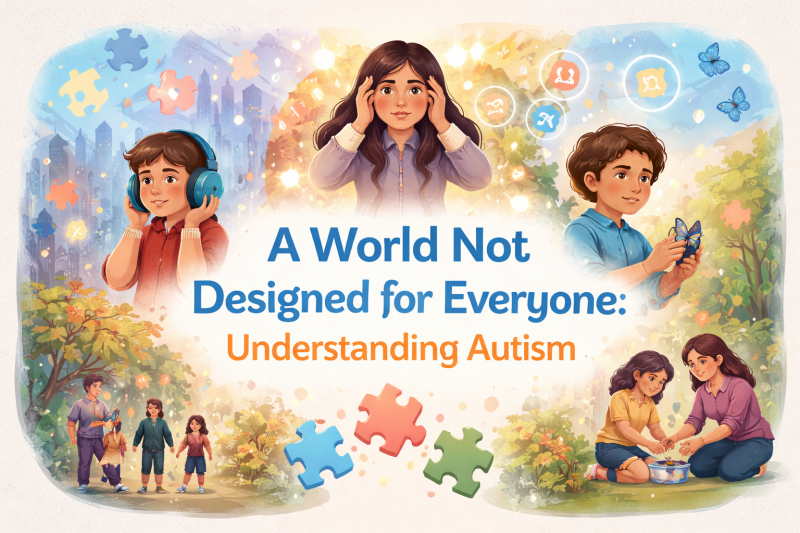
The burden of adaptation is often placed on the Autistic individual, not the environment.
How Autistic People Experience the World
People with Autism Spectrum Disorder are affected in many ways such as the way they communicate and socialize with others. They can become easily overwhelmed by aspects of the environment such as bright lights and loud noises that are hard to avoid in our society. They can also seek out some types of sensory stimulation like rocking that might not be accepted in social situations [1].
Those with autism also face challenges when taking the literal meaning of words. With our society using more slang, sarcasm and symbolic language, it’s important that as a society there are more steps taken to create a more inclusive world for Autistic people.
Unfortunately, society isn’t naturally designed with these differences in mind. Therefore, many forms of therapies exist to help autistic individuals navigate it.
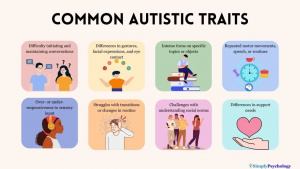
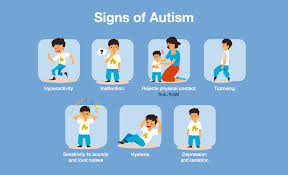
Image 1 sourced from synlab.com. Image 2 sourced from simplypsychology.org.
Therapies
Since there is no cure for the disorder itself, therapies are given to help people navigate a world that wasn’t built for them.
Applied behavior analysis (ABA) is one of the most common types of treatment. The goal of ABA is to increase communication skills, increase helpful behaviors, decrease harmful behaviors, and improve attention. [2] The Early Start Denver Model (ESDM) is an applied behavior analysis therapy focused towards 1–2-year-olds [3]. These techniques are great at improving their skills but, they often center on shaping behavior to better align with social expetaions.
Speech and Language Therapy are used to improve the individual’s communication whether it’s verbal, gestured or through an electronic device [4].
Occupational Therapy is also commonly used to help the person improve their sensory input in turn reducing their anxiety [3]. A focus of this is to help those with ASD tolerate loud noises and bright spaces. It is vital that society creates more inclusive spaces rather than just creating an expectation that neurodivergent people just tolerate their environment.
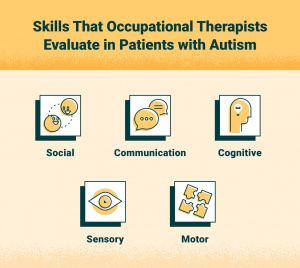 Image sourced from usa.edu
These therapies do a great job with helping the autistic individuals adapt however, it still reflects the broader problem of placing the responsibility on the individual not the environment.
Medications are often prescribed to manage high energy levels as 81.2% of children with ASD also have ADHD [5]. Often, these medications are prescribed to improve their attention and productivity. This shows how schools and work environments prioritize sustained attention and controlled behavior. The most commonly prescribed ADHD medications are Vyvanse, Concerta, and Adderall [6]. These 3 medications all affect dopamine signaling in the brain which is what regulates motivation, reward and attention [7].
Two other medications, Risperidone and Aripiprazole, are the only FDA-approved medications for treating irritability and aggression in children (5 and older) with autism. They also involve dopamine signaling but, they are also prescribed for mood and psychotic disorders [8].
This poses the question, how much of what is being treated is a symptom of autism spectrum disorder or a symptom of living in environments that weren’t built with them in mind?
Neurodiversity offers valuable perspectives and insights that benefit in society greatly. While therapies offer important support, there is still a lack of understanding and inclusivity of autistic individuals. This is why autism advocacy is so important.
Sources:
Featured image sourced from ChatGPT
2. Applied Behavior Analysis (ABA). (n.d.). Retrieved March 18, 2026, from https://www.autismspeaks.org/applied-behavior-analysis
3. CDC. (2024, July 18). Treatment and intervention for autism spectrum disorder. Autism Spectrum Disorder (ASD). https://www.cdc.gov/autism/treatment/index.html
4. Speech Therapy. (n.d.). Retrieved March 18, 2026, from https://www.autismspeaks.org/speech-therapy
5. DiCarlo, G. E., & Wallace, M. T. (2022). Modeling dopamine dysfunction in autism spectrum disorder: From invertebrates to vertebrates. Neuroscience and Biobehavioral Reviews, 133, 104494. https://doi.org/10.1016/j.neubiorev.2021.12.017
6. Medications for attention-deficit hyperactivity disorder. (n.d.). Retrieved March 18, 2026, from https://caringforkids.cps.ca/handouts/behavior-and-development/medications-for-attention-deficit-hyperactivity-disorder
7. Baik, J.-H. (2013). Dopamine Signaling in reward-related behaviors. Frontiers in Neural Circuits, 7. https://doi.org/10.3389/fncir.2013.00152
8. Alsayouf, H. A., Talo, H., Biddappa, M. L., & De Los Reyes, E. (2021). Risperidone or aripiprazole can resolve autism core signs and symptoms in young children: Case study. Children, 8(5), 318. https://doi.org/10.3390/children8050318
