
Schizophrenia is hypothesized to be a brain development disorder. [1] In contrast to most developmental disorders, it most commonly does not surface until ages 16-30. [2] It is difficulty to study because it is caused by combinations of various things including inherited genes, genetic mutations, and environmental factors. In addition, the presentation of this disorder varies between individuals, and many symptoms are often mistaken for other disorders, like depression. [1,3] Specific genes and gene mutations have found to be associated with developing schizophrenia, but there is nothing found to be consistent across all or most individuals. [1] Due to the diversity among causes and pathophysiology, this disorder is difficult to study and still largely not understood.
Symptoms
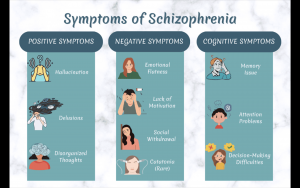
Common symptoms associated with schizophrenia are grouped into three categories. Positive Symptoms of schizophrenia include delusions, hallucinations, disorganized speech/thinking, and disorganized/abnormal behavior (involuntary movement, coordination struggles, agitation). Negative symptoms include lack of motivation, withdrawing from activities and social engagement, and difficulty with typical functioning. Cognitive symptoms include troubles with attention, concentration, memory, and processing information. [3]
Comorbidities
Common comorbidities, or disorders that often occur with schizophrenia, are anxiety disorders (panic disorder, post-traumatic stress disorder, and obsessive-compulsive disorder), depression, and substance abuse. [5]
Pathophysiology
A major hypothesis of the etiology of schizophrenia is abnormalities with brain development, neural connections, and signaling pathways. In addition, a large contributor of this disorder is too much dopamine. The Wnt signaling pathway is thought to largely contribute to the pathophysiology of schizophrenia. This pathway is involved in the formation of neural circuits and synaptic plasticity. [1] Synaptic plasticity is crucial in development and involved in learning and memory.
Click here to learn more about the Wnt signaling pathway
Current Treatments
Antipsychotics
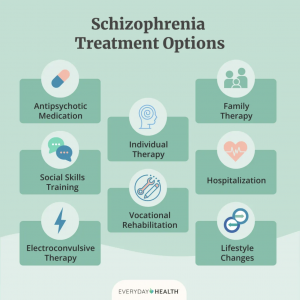
Antipsychotics are the primary treatment of schizophrenia. Most antipsychotics block dopamine receptors (as mentioned above, there is too much dopamine in schizophrenia). Clozapine is commonly prescribed. In addition to decreasing dopamine signalling, these drugs are also thought to help regulate the Wnt signaling pathway. [1] A new antipsychotic (Xanomeline and Trospium chloride) used for the treatment of schizophrenia acts on acetylcholine receptors instead of dopamine. [6]
Additional Medications
Lithium helps with mood-balancing, targeting the extreme highs and lows and shrinking that emotional range, which can be helpful with schizophrenia as well as some of its comorbidities. Lithium also helps regulate the Wnt signaling pathway. [1] Long-acting injectable antipsychotic agents (LAI) act in the same way as antipsychotics but are administered as an injection every 2-4 weeks. These are only used with patients who do not adhere to an oral medication or have difficulties with an oral medication. Medications for schizophrenia can have many side effects, so it is not uncommon for an individual to not want to take them. [6,7]
Therapy
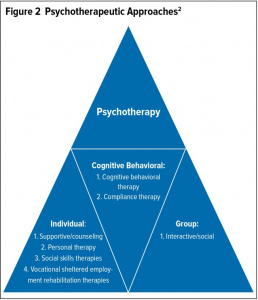
There are various therapeutic approaches used with clients with schizophrenia. Therapy is usually in addition to an antipsychotic to help with remain symptoms, thought patterns, and ensure the client is taking their medication. There are three main groups of therapy applied: individual, group, and cognitive behavioral. Group therapy emphasizes support, interactions, and social skills. Both individual and cognitive behavioral primarily target thought patterns and coping strategies. Two specific types of individual therapy that are common are “social skills therapy” and “vocational sheltered employment rehabilitation therapies.” Social skills therapy focuses on communication, social interactions, and participating in daily life. Vocational sheltered reemployment rehabilitation therapy targets getting hired and keeping a job. [6,7]
Lifestyle
Lifestyle practices are extremely important for individuals with schizophrenia. Sleep, avoiding alcohol and drugs, goal setting, relaxation and stress management, education about schizophrenia, and support groups are all important for minimizing the harmful aspects of this disorder. [6]
Electroconvulsive Therapy
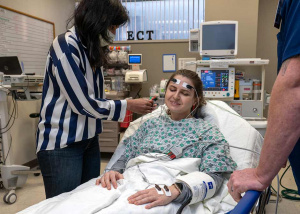
Electroconvulsive therapy (ECT) is used as a sort of last resort in the treatment of schizophrenia. It is only used for patients who do not respond to medication. It involves causing a therapeutic seizure from electrical currents through the brain.[6]
Researchers has come a long way, however, there is still so much we do not understand about schizophrenia, its development, and effective treatments for individuals. Current medications have a lot of side effects, to the point that individuals may avoid taking them. And even while individuals continuously take their medications, symptoms and struggles remain. Researchers have identified genes and mutations that are consistent across some individuals with schizophrenia, and many neurotransmitters and signaling pathways have been implicated, but the pathology of schizophrenia is still largely not understood. Continued research is crucial for understanding this disorder better and being able to develop more effective treatments.
[1] Singh, K. (2013). An emerging role for Wnt and GSK3 signaling pathways in schizophrenia. Clinical Genetics, 83(6), 511–517. https://doi.org/10.1111/cge.12111
[2] Newell, T., & Gopal, A. (n.d.). Mental Health and Schizophrenia. WebMD. Retrieved March 24, 2026, from https://www.webmd.com/schizophrenia/mental-health-schizophrenia
[3] Noble, D. (2026, February 19). Understanding the 3 symptom domains of schizophrenia—Positive, negative and cognitive symptoms. Mayo Clinic Press. https://mcpress.mayoclinic.org/schizophrenia/understanding-the-3-symptom-domains-of-schizophrenia-positive-negative-and-cognitive-symptoms/
[4] NCC, D. G., LCPC. (2024, August 19). Understanding Schizophrenia: What Families Need to Know About Schizophrenia. New Perspectives Counseling Services. https://newperspectivescs.com/understanding-schizophrenia/
[5] Buckley, P. F., Miller, B. J., Lehrer, D. S., & Castle, D. J. (2009). Psychiatric comorbidities and schizophrenia. Schizophrenia Bulletin, 35(2), 383–402. https://doi.org/10.1093/schbul/sbn135
[6] Mayo Foundation for Medical Education and Research. (2024, October 16). Schizophrenia. Mayo Clinic. https://www.mayoclinic.org/diseases-conditions/schizophrenia/diagnosis-treatment/drc-20354449
[7] Patel, K. R., Cherian, J., Gohil, K., & Atkinson, D. (2014). Schizophrenia: Overview and Treatment Options. Pharmacy and Therapeutics, 39(9), 638–645.
[8] Electroconvulsive Therapy (ECT) | Ohio State Medical Center. (n.d.). Retrieved March 24, 2026, from https://wexnermedical.osu.edu/mental-behavioral/interventional-psychiatry/ect
[9] Switching Medications: What to Do if Your Schizophrenia Treatment Isn’t Working. (n.d.). EverydayHealth.Com. Retrieved March 24, 2026, from https://www.everydayhealth.com/mental-health-conditions/switching-medications-if-your-schizophrenia-treatment-isnt-working/
