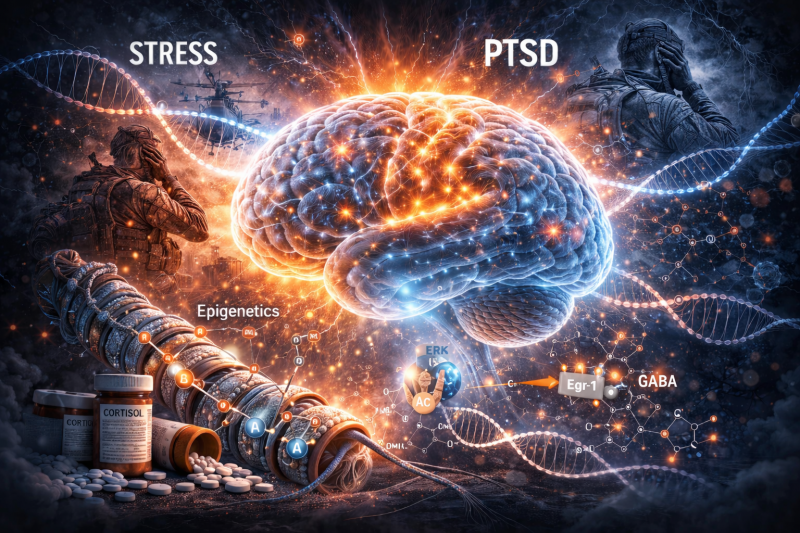
Feature image created by K. Leppke with help of ChatGPT
The Story of a Stressful Memory
Why do some moments fade while others remain stuck within the memory? The answer centers around brain stress hormones, neural signaling, and DNA packaging processes working together to wire these experiences into our memory. Stressful experiences create powerful memories that, evolutionarily, helped us adapt to our environments and be successful. When we experience something stressful, our body releases glucocorticoid hormones, like cortisol [1]. These hormones travel to the brain, especially to the hippocampus, where they help build memories.
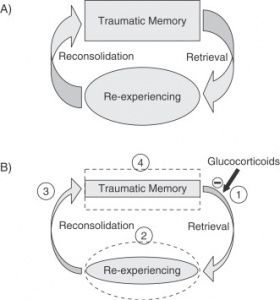
Figure 1: Glucocorticoids help form traumatic memories by strengthening the encoding and retrieval of the traumatic memory. This increases the likelihood of vivid re-experiences of that memory. During reconsolidation glucocorticoids reinforce this memory every time it is retrieved, making it more stable. This cycle boosts the emotional intensity and persistence of the traumatic memory [7].
Glucocorticoids interact with brain cells to activate a powerful signaling cascade, called the ERK-MAPK pathway [1]. This pathway passes extracellular information into the nucleus, where DNA is. However, sometimes the memories that form in this process become too strong, contributing to disorders like anxiety and PTSD. Therefore, understanding the mechanism behind these memories is crucial for understanding both resilience and vulnerability to various disorders.
Memory & Genetics
Memories are stored through changes in brain cells, but don’t alter the DNA sequence itself. The brain uses epigenetics, which are chemical modifications that control how genes are turned on or off. In stressed neurons, signaling cascades lead to modifications on proteins called histones, which control packaging of DNA. Two specific changes occur with these histones [1]:
- Phosphorylation on S10
- Acetylation on K14
Together, these changes are referred to as H3S10p-K14ac and they open up the DNA. This is what allows certain genes to be activated. Two important genes that are activated are important for memory formation and are in the group called immediate early genes (IEGs). These genes are[1]:
- c-Fos
- Egr-1
Therefore, PTSD and anxiety disorders can be examined on a genetic level. Both are influenced by many genetic variants that collectively increase risk for the development of these disorders. Genetic variants associated with anxiety also relate to structural changes in the brain, such as a reduced volume in the amygdala, which directly effects fear conditioning [2]. The genetic predisposition for PTSD often overlaps with genes that influence personality traits, meaning those at risk are often risk-takers, have poor organization, increased self doubt, and are unstable [3].
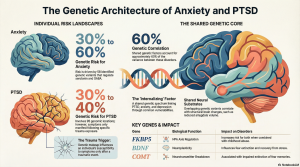
Figure 2: This figure shows how genetic and environmental factors contribute to anxiety and PTSD. A significant portion of risk, between 30–60% [4], is genetic for anxiety and 30-40% [5] of risk for PTSD is genetic. They have shared key genes like FKBP5, BDNF, and COMT that influence stress response, memory, and emotional regulation. PTSD and anxiety disorders arise from inherited biological pathways and life experiences, specifically exposure to stress or trauma (figure created by GoogleNotebook) [6].
Learning & Emotions Through Stress
Through experimentation with rats, researchers found that strong memories of the stressful event lead to learning and adaptation to that event in the future. They found that if these scenarios occur, they are key to this process:
- If glucocorticoid signaling is blocked the memory doesn’t form properly
- If the ERK-MAPK pathway is disrupted the memory formation fails
- If epigenetic changes don’t occur the learned adaptation won’t occur either
Anxiety levels change how strongly memories form. Therefore, emotional state shapes the biology of memory. GABA, a neurotransmitter which calms signaling, regulates this system. Research has found antianxiety drugs to reduce memory based gene activation. Anxiety inducing drugs amplify these molecular responses, promoting memory formation. This suggests that more anxious people may form stronger stress memories.
Conclusion
Memories are being actively built in the brain by specific hormone and molecular pathways, which epigenetically change the brain to prepare for similar situations in the future. Stressful experiences help us learn and survive through these memories. When the system becomes overactive, it can lead to anxiety disorders and PTSD. This causes these memories to seem like active stress situations, rather than a past experience which can be drawn on for learning or adaptation. Therefore, understanding these mechanisms could lead to better treatments that target memory formation at its roots, and decrease the stress levels the brain puts on itself through these mechanisms.
References
[1] Reul, J. M. H. M. (2014). Making Memories of Stressful Events: A Journey Along Epigenetic, Gene transcription, and Signaling Pathways. Front. Psychiatry 5.
[2] Vander Merwe, C., Jahanshad, N., Cheung, J. W., Mufford, M., Groenewold, N. A., Koen, N., Ramesar, R., Dalvie, S., ENIGMA Consortium PGC-PTSD, Knowles, J. A., Hibar, D. P., Nievergelt, C. M., Koenen, K. C., Liberzon, I., Ressler, K. J., Medland, S. E., Morey, R. A., Thompson, P. M., & Stein, D. J. (2019). Concordance of genetic variation that increases risk for anxiety disorders and posttraumatic stress disorders and that influences their underlying neurocircuitry. Journal of affective disorders, 245, 885–896. https://doi.org/10.1016/j.jad.2018.11.082
[3] Gottschalk, M. G., & Domschke, K. (2017). Genetics of generalized anxiety disorder and related traits. Dialogues in clinical neuroscience, 19(2), 159–168. https://doi.org/10.31887/DCNS.2017.19.2/kdomschke
[4] Domschke, K., & Maron, E. (2013). Genetic factors in anxiety disorders. Modern trends in pharmacopsychiatry, 29, 24–46. https://doi.org/10.1159/000351932
[5] DiCorato, A. (2024). Genome-wide association analyses identify 95 risk loci and provide insights into the neurobiology of post-traumatic stress disorder. Nature Genetics. DOI: 10.1038/s41588-024-01707-9.
[6] Fox-Gaffney, K. A., & Singh, P. K. (2025). Genetic and Environmental Influences on Anxiety Disorders: A Systematic Review of Their Onset and Development. Cureus, 17(3), e80157. https://doi.org/10.7759/cureus.80157
[7] Dominique J. (2007). Glucocorticoid-induced reduction of traumatic memories: implications for the treatment of PTSD. Progress in Brain Research; Elsevier. Pages 239-247. https://doi.org/10.1016/S0079-6123(07)67017-4.
