Autism Spectrum Disorder
Autism Spectrum Disorder (ASD) is characterized by deficits in social communication and interaction, restricted interest, and/or repetitive behaviors. ASD is a wide spectrum that is diagnostically it is broken into three levels. Biologically ASD also varies, and it is theorized that there are many subtypes within this classification. Individuals with ASD are also more likely to be diagnosed with psychiatric disorders (especially ADHD, ODD, and anxiety disorders), multisystem disorders (especially Gastrointestinal disorders), and seizures (specifically epilepsy). [1,2]
Genetic and Environmental factors
There is no single cause of ASD. It is more of a label for a group of symptoms that seems to be more likely to occur with certain factors. Just as there is not a single cause, there is not a single gene that results in ASD, but rather many genes that seem to contribute to the likelihood of developing this disorder. Different gene mutations are thought to partially be responsible for the subtypes within ASD – two genetic mutations that result in ASD are fragile X syndrome and Rett syndrome. Environmental factors, especially during pregnancy, are also involved in the development of ASD. For example, maternal infection and exposure to toxins, such as anticonvulsant valproic acid (VPA), seem to also contribute to the development of ASD. [1]
Fragile X syndrome and Rett syndrome
Fragile X is a genetic mutation. It is the leading cause of inherited intellectual disability; symptoms include physical abnormalities, behavioral issues, developmental delays, intellectual and learning disabilities, anxiety, ADHD, and ASD. It has no cure, but medications and therapies are used to treat symptoms. The protein affected by this genetic mutation is important in the development of synapses and modulation of dopamine in the forebrain. [3,4]
Rett syndrome is also a genetic mutation; however, unlike Fragile X syndrome, it is not inherited but rather a genetic change that occurs spontaneously . It affects movement, communication, behavior, cognitive abilities, and brain development. Similarly to Fragile X syndrome, there is not cure, but medications and therapies are used to treat symptoms. [5] There is a decrease in dopamine that is seen in this disorder. [6]
Dopamine
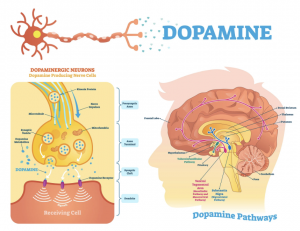
Dopamine is a neurotransmitter involved in learning, motivation, attention, and social and repetitive behaviors. The brain produces dopamine in the substantia nigra, ventral tegmental, and a small amount in the hypothalamus. Dopamine dysfunction is thought to be the main cause of one of these subtypes of ASD. [1] The idea that dopamine dysfunction is a contributor to ASD is Supported by the fact that it effects aspects of many theories as to the development of autism: it impacts how neurons communicate and connect with one another and is hypothesized to be involved in sensory processing – many children with autism have sensory issues and sensitivities. [1,7]
[1] DiCarlo, G. E., & Wallace, M. T. (2022). Modeling Dopamine Dysfunction in Autism Spectrum Disorder: From Invertebrates to Vertebrates. Neuroscience and Biobehavioral Reviews, 133, 104494. https://doi.org/10.1016/j.neubiorev.2021.12.017
[2] Autism spectrum disorder (ASD) | Autism Speaks. (n.d.). Retrieved March 17, 2026, from https://www.autismspeaks.org/what-autism
[3] What Is Fragile X Syndrome (FXS)? (n.d.). Cleveland Clinic. Retrieved March 17, 2026, from https://my.clevelandclinic.org/health/diseases/5476-fragile-x-syndrome
[4] Wang, H., Kim, S. S., & Zhuo, M. (2010). Roles of Fragile X Mental Retardation Protein in Dopaminergic Stimulation-induced Synapse-associated Protein Synthesis and Subsequent α-Amino-3-hydroxyl-5-methyl-4-isoxazole-4-propionate (AMPA) Receptor Internalization. The Journal of Biological Chemistry, 285(28), 21888–21901. https://doi.org/10.1074/jbc.M110.116293
[5] What Is Rett Syndrome? (n.d.). Cleveland Clinic. Retrieved March 17, 2026, from https://my.clevelandclinic.org/health/diseases/6089-rett-syndrome
[6] Wenk, G. L. (1995). Alterations in Dopaminergic Function in Rett Syndrome. Neuropediatrics, 26(2), 123–125. https://doi.org/10.1055/s-2007-979741
[7] Sensory issues | Autism Speaks. (n.d.). Retrieved March 17, 2026, from https://www.autismspeaks.org/sensory-issues
[8] What Is Dopamine In The Brain. (2025, June 6). https://www.simplypsychology.org/the-role-of-dopamine-as-a-neurotransmitter-in-the-human-brain.html
