Artstract by A. Griffith – Created with OpenAi
In the United States, 58.3% of the population used tobacco products, vaped nicotine, drank alcohol, or used an illicit drug within the previous month of the Substance Abuse and Mental Health Services Administration survey. [1] Addiction is prevalent and an important topic of treatment research, especially considering the physical and mental health impairments that accompany it. There are various theories of addiction and what is happening in the brain, the etiology, what causes behaviors, etc. When thinking about addiction, we often focus on reward. Dopamine and reward are a large part of what is occurring, but at its core addiction is an issue with learning and memory. Mechanistically in the brain, glutamate is largely involved in learning and memory implicating it in addiction as well. [2]
Addiction & Substance Use Disorder
Substance Use Disorder (SUD) is characterized by difficulty to limit drug intake and chronic relapsing. Psychostimulant Use Disorder (PUD) is a SUD with specifically psychostimulants, which include, cocaine, nicotine, and amphetamine-like drugs (methamphetamine). Drugs increase the dopamine present in the nucleus accumbens which results in tolerance, sensitization, and adaptation. There are no FDA-confirmed medications for the treatment of these disorders. [2]
Dopamine and Reward
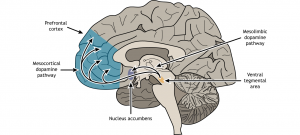
The reward circuitry in the brain motivates drug use. Drug abuse physically alters brain connectivity, receptor and transporter expression of dopamine, and the synthesis and release of neurotransmitters involved in the reward circuit, including dopamine. Psychostimulants affect dopamine in multiple ways: binding to dopamine receptors, increasing dopamine release, inhibiting reuptake of dopamine, and decreasing the metabolism of dopamine. All of these cause more dopamine to be present and contribute to the “high” feeling that is sought in the reward cycle, as well as more of the substance being needed to have the same effect as it is continued to be used. [2]
Glutamate
Glutamate is essential for synaptic plasticity, or the ability of the brain to form new connections, which is a large part of learning and memory. Receptors of the neurotransmitter glutamate include the inotropic receptors NMDA, AMPA, and kainite and the metabotropic receptors, or mGluRs, which are divided into three groups (Group I, Group II, Group III). [2]
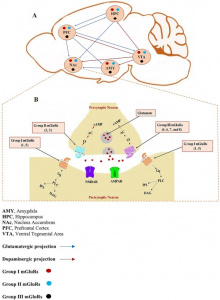
Group I mGluRs are primarily located on postsynaptic neurons. They interact with the Gq protein in G protein-coupled receptors and lead to the second messengers IP3 and DAG. In some cases, blocking these receptors decreases drug seeking behaviors. [2]
Group II & III
Group II and III mGluRs are primarily located on presynaptic neurons and lead to the inhibition of adenylyl cyclase, and therefore the second messenger cAMP. They modulate neurotransmission, decreasing the chances of neurotransmitter release. This means they decrease the chance of dopamine being released, so agonists of these receptors have been implicated in reducing relapse. [2]
As part of the learning process, drug abuse affects the synaptic strength of neurons. This includes how neurons are physically wired together, as well as the receptors they express in the membrane; synaptic strength is modulated by glutamate. In drug abuse, the brain actually strengthens synapses to prepare to receive the same signal again. This is memory formation – the brain is actually rewired to “want” the drug again and become dependent on it. This increased synaptic strength is connected to relapse. [2]
Studies have shown that inhibiting glutamatergic inputs, blocking specific group I mGluRs, and agonists of group II & potentially group III mGluRs in animal models have prevented relapse and decreased drug seeking behaviors. The connection to glutamate and learning makes modulating glutamatergic neurotransmission a promising treatment for SUDs, particularly for the associated cognitive symptoms. Addiction is the brain learning from drug intake and forming memories to prepare for it to happen again, therefore, targeting this learning system is a potential to break the cycle of addiction and relapse.
Footnotes
[1] SAMHSA Releases Annual National Survey on Drug Use and Health. (2025, July 28). https://www.samhsa.gov/newsroom/press-announcements/20250728/samhsa-releases-annual-national-survey-on-drug-use-and-health
[2] Mozafari, R., Karimi-Haghighi, S., Fattahi, M., Kalivas, P., & Haghparast, A. (2023). A review on the role of metabotropic glutamate receptors in neuroplasticity following psychostimulant use disorder. Progress in Neuro-Psychopharmacology and Biological Psychiatry, 124, 110735. https://doi.org/10.1016/j.pnpbp.2023.110735
[3] Henley, C. (2021). Motivation and Reward. https://openbooks.lib.msu.edu/neuroscience/chapter/motivation-and-reward/
