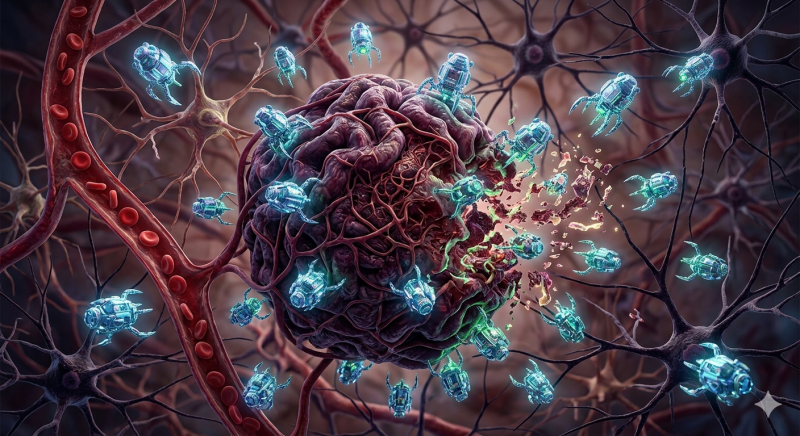
Artstract made by Eli Hunt using Google Gemini
Glioblastoma is a category of cancer that forms in the brain and is a very rapidly advancing cancer with poor survival rates. One of the main reasons it is such a difficult disease to treat is because of the variation seen in glioblastoma, with some cells having different mutations than other cells, posessing heterogeneity not seen in other cancers. This allows glioblastoma to adjust to drugs and this makes glioblastoma pretty much impossible to treat using pharmaceutical approaches. It is also very difficult to surgically remove due to how rapidly it spreads and the fact that it is in the brain, making surgery very risky and for the most part unsuccessful long-term. For these reasons, glioblastoma and other difficult cancers to treat need a non-traditional approach to treatment and nanobots are looking more and more like the answer.
Why Glioblastoma is Uncurable with Traditional Cancer Treatment
As mentioned earlier, glioblastoma has heterogeneity not seen in most other cancers. . This heterogeneity makes glioblastoma effective at resisting drugs, and there is often much trial and error due to there not being a typical way to treat it. This trial and error takes time most patients do not have, with a median life expectancy of 12-18 months and only around 5% living 5 or more years (1). Due to this heterogeneity drug treatments just give the patient a little extra time, because as the drug kills off cells of one mutation, the cells with other mutations take over and then the drug is no longer effectively killing the cancer cells quicker than they can divide. Additionally, drugs must pass through the blood brain barrier to get to the tumor, an obstacle drugs do not need to pass for other forms of cancer. This makes it difficult to get high enough concentrations of drugs into the brain to effectively treat the cancer.

Some of the most common mutations seen are EGFR mutations, seen in around 40% of glioblastoma cases. These mutations occur on the receptors where growth hormones bind, leading to overexpression of growth in the cell. TP53 mutations are also relatively common in glioblastoma cases. TP53 is a key tumor suppressor, it works by stopping cells with mutated DNA from duplicating. So when there is a mutation resulting in a lack of this, it leads to cancer. Most glioblastoma cases involve mutations involving growth factor genes or tumor suppressant genes. The cocktail of mutations varies case to case, with is what makes a universal form of treatment difficult.
Another traditional cancer treatment is tumor removal through surgery. Well glioblastoma has a counter for this as well. Not only is it located in the brain, arguably the most dangerous part of the body to get surgery with very little margin for error, but it is difficult to get every last bit of glioblastoma. It is a very invasive form of cancer, spreading microscopically into healthy tissue and often not having a defined boundary of where the tumor begins and ends. This results in invisible cancer cells that cannot be seen in surgery or MRIs due to how little of a concentration there is. This invasiveness means that often with surgery, there is going to be residual glioblastoma leftover that will only grow back within a matter of months. This makes surgery another form of increasing patients lifespan rather than curing them.
These are just a few examples of why glioblastoma is so difficult to treat. To see the full science and more reasons why, check out this article. For all of these reasons, developing further traditional cancer treatments for glioblastoma is, in my opinion, never going to work. To treat glioblastoma, brand new areas of cancer treatment are required and the area with the most promise is nanobots. Nanobots are such a promising and inexpensive form of treatment for not just glioblastoma but all forms of cancer. Pursuing nanobots as treatment could possibly lead us to a future where cancer is no longer nearly as deadly and will be easy to treat.
Using Nanobots as Treatment
Using nanobots as a treatment option is essentially artificially remaking the bodies natural defenders to cancer. T-cells are typically seen as the “frontline soldiers” in the fight against cancer. But sometimes cancer can disguise itself from these cell, making these cells no longer effective. What cancer cannot do however, is trick a computer. Additionally, we can modify nanobots to our needs, something we can’t really do to the same extent to T-cells. Nanobots offer a non-invasive solution to all cancers, giving us the effectiveness of surgical removal while maintaining the non-invasiveness of drug treatment. Best of all, it offers a more targeted removal of cancer cells compared to the scorched Earth effect of typical cancer drugs. This can help patients avoid the negative side effects of chemotherapy drugs.
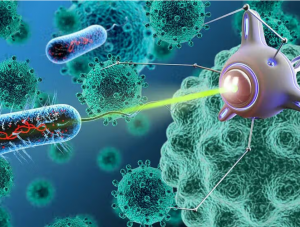
Nanobots are a lot closer to being used than many people think as well, they are something that is realistically possible to see in the next couple decades and most likely to be seeing use at some point in our lives. They work in a variation of ways, but in general, they all work in a more or less similar way. They are inserted into our bloodstream and travel throughout the body and scan cells to identify malignant cancer cells. The debate for their use comes after this point, with some scientists thinking they should be used to deliver traditional cancer medications in a more targeted ways. Other scientists think the nanobots should be used to destroy cancer cells directly, whether its through some sort of mechanical or thermal device, some scientists believe the nanobots should be equipped to destroy the cancer themselves. By using nanobots we can effectively identify cancer cells, destroy them in a targeted way, and help us avoid the negative effects seen in traditional cancer treatment. But there are still some hurdles to nanobot treatment.
Some hurdles that need to be figured out before nanobots are used on a wide scale are, where do the nanobots go after they are done, large scale production, and lowering costs of creation. The latter two problems are things that should naturally solve themselves with how rapidly technology is advancing and the high demand that these nanobots will create but are still nonetheless a problem currently. Especially as AI advances and the rapid rate we are building computers smaller and smaller and faster than ever before the production cost problems should naturally lower as these technologies become more common But the biggest problem is where do these nanobots go when they are done? Many nanobots are being designed to be biodegradable through natural bodily processes and be removed through natural methods such as urination. Other paths for nanobot removal being explored are programming them to go to certain parts of the body or being removed through external magnets. These safety issues are critical to future development but are challenges that can realistically be solves. So while nanobots still have quite a ways to go before we see them in clinical use, they are not as far as some of us may think and their likelihood of being used in our lifetime as a treatment for cancer and other diseases is quite high. For a comprehensive review on the advances of nanobot treatments, this article is a great place to get further information.
Sources
1. (2026). Glioblastoma survival rates. Mayo Clinic. https://www.mayoclinic.org/diseases-conditions/glioblastoma/survival-rates/gnc-20596050
2. Pietrango, A. (2018). Scientists developing nanobots whose mission is to kill cancer tumors. Healtline.com. https://www.healthline.com/health-news/scientists-developing-nanorobots-to-kill-cancer-tumors
3. Frellick, M. (2017). Poll: half of doctors, nurses have put off giving bad news. Medscape.com. https://www.medscape.com/viewarticle/889116
Information about glioblastoma- Fung, N. H., Grima, C. A., Widodo, S. S., Kaye, A. H., Whitehead, C. A., Stylli, S. S., & Mantamadiotis, T. (2019). Understanding and exploiting cell signalling convergence nodes and pathway cross-talk in malignant brain cancer. Cellular signalling, 57, 2–9. https://doi.org/10.1016/j.cellsig.2019.01.011
Information about nanobots- Kong, X., Gao, P., Wang, J., Fang, Y., & Hwang, K. C. (2023). Advances of medical nanorobots for future cancer treatments. Journal of hematology & oncology, 16(1), 74. https://doi.org/10.1186/s13045-023-01463-z
