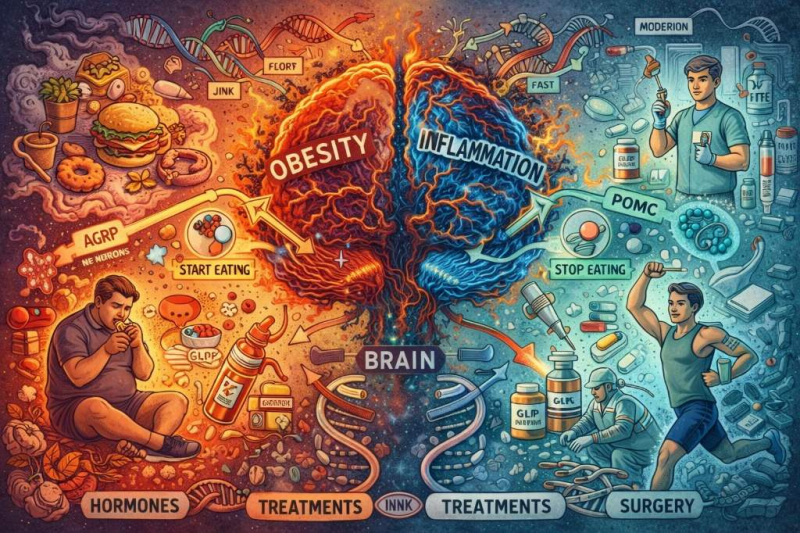
More than just willpower: The Brains role in Obesity[1]
For many years, we have been told that weight management is a “simple”: eat better, do more exercise, and move more. It is a narrative of personal responsibility, where diet and exercise are said to be the primary tools for maintaining a healthy body.
However, a research from 2017, is painting this a much more complex biological picture. We now know that obesity does more than just affect peripheral organs, it induces a state of systemic, low-grade inflammation that actually alters the brain. Specifically, the consumption of calorie-dense, high-fat diets trigger inflammation in the hypothalamus, which is the brains control center for energy homeostasis. This inflammation disrupts the critical neurocircuits that signal satiety, essentially leading to insulin and leptin resistance. This means that for many, obesity is not just a failure of willpower, but a physiological disruption of the very signals that tell us when to eat and when to stop.
Therefore, if we want to effectively address and treat obesity, we have to look beyond traditional advice and understand the cellular and molecular mechanisms at play. By recognizing these inflammatory pathways in the brain, we can better appreciate how modern medical treatments which range from behavioral changes to targeted pharmaceutical interventions, work to restore the brain’s natural metabolic balance.
The Science behind this struggle [2]
To understand why “just eating less” is so hard for some people, we have to look at the hypothalamus. This tiny area of the brain integrates metabolic feedback to regulate energy homeostasis.
When our systems are working correctly, hormones like insulin and leptin act on two specific populations of neurons in the arcuate nucleus (ARC):
AgRP Neurons: The “start eating” signals (orexigenic)
POMC Neurons: The “stop eating” signals (anorexigenic)
However, high-fat diets trigger inflammatory pathways (involving mediators like JNK and IKK) that rapidly activate even before significant weight gain occurs. This inflammation essentially “breaks” the signaling loop, meaning your brain can no longer effectively “hear” the signals telling you that you are full.
Treatments
Since the root of the problem is often biological, approach to treatment has shifted from purely behavioral to more targeted, science-based interventions. Here is a breakdown of how current treatments aim to restore that balance
1. The Lifestyle Foundation[3]
Dietary changes and physical activity remain the absolute foundation of weight management
- Diet: Cutting calories, choosing nutrient-dense foods, and utilizing meal replacements
- Exercise: Targeting at least 150 minutes of moderate-intensity activity per week
- Behavioral Support: Counseling and support groups are essential for addressing the emotional and behavioral components of eating, which helps manage anxiety and habits
2. Targeted Medications
Modern obesity drugs are revolutionary because they often target the exact hypothalamic pathways disrupted by inflammation.
- GLP-1 Receptor Agonists (like Semaglutide/Wegovy and Liraglutide): These mimic natural hormones released after eating to signal fullness. They work by activating POMC neurons and inhibiting AgRP neurons, helping to suppress appetite and improve metabolic signaling. [4]
- Combination Therapies (like Bupropion-Naltrexone/Contrave): These sustain activity in POMC neurons to reduce appetite and block the feedback mechanisms that usually shut those signals off, prolonging the “satiety” feeling. [5]
- Gut-Targeted Options (like Orlistat): These work outside the brain by inhibiting the enzymes that break down dietary fat, preventing about 30% of fat absorption. [6]
3. Procedural and Surgical Interventions[7]
When lifestyle changes and medication are not enough, medical procedures can provide the necessary physical intervention to assist with weight loss.
- Endoscopic Procedures: Options like intragastric balloons or endoscopic sleeve gastroplasty physically reduce the space available in the stomach, helping patients feel full faster with less food.
- Bariatric Surgery: Gastric bypass or sleeve surgeries create smaller reservoirs for food, which drastically alters how the body processes intake and, in many cases, leads to rapid improvements in metabolic health.
Conclusion
Older treatments focused almost exclusively on calories and behavior. While those are still important, we are entering a new era where we can treat obesity by targeting specific brain pathways, like POMC, GLP-1, and melanocortin systems, that hypothalamic inflammation has disrupted.
A good thing to remember is that it’s not just about “trying harder.” It’s about working with your body’s biology to get those hunger and satiety signals back on track.
[1] Jais and Brüning, “Hypothalamic Inflammation in Obesity and Metabolic Disease.”
[2] Jais and Brüning, “Hypothalamic Inflammation in Obesity and Metabolic Disease.”
[3] “Obesity – Diagnosis and Treatment – Mayo Clinic.”
[4] Mathialagan et al., “Obesity and Current Treatment Approaches.”
[5] Obes. Med. Assoc., “Top Weight Loss Medications.”
[6] Obes. Med. Assoc., “Top Weight Loss Medications.”
[7] “Obesity – Diagnosis and Treatment – Mayo Clinic.
