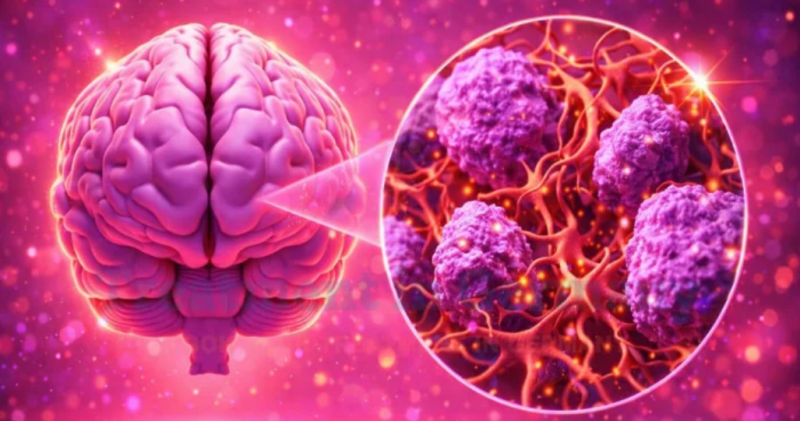
Feature image from Medical Treatment in Germany. [2]
What is Glioblastoma?
Glioblastoma is one of the deadliest cancers with extremely low survival rates, of about 14 months.[1] Most other cancers have possible treatment options with the removal of tumors. Glioblastoma, however, spreads cancer cells very quickly and easily. This makes recurrence extremely common, even when tumor was completely removed. Surgery, radiation, and the chemotherapy drug temozolomide are the current “treatment” options, but they rarely cure it.[1] Learning more about the development and mechanisms within glioblastoma such as the communication, breakdown, and adaptation of cells signaling inside the brain may direct possible ways to combat this deadly disease.
Glioblastoma Mechanisms
To understand how glioblastoma is so resilient, it is central to understand how cells communicate and take over. Inside the brain thousands signaling pathways are constantly occurring. These act like chains of molecular interactions that control behavior, growth, movement, and survival[1]. There are three major signaling pathways that glioblastoma hijacks:
- MAPK
- Regulates cell proliferation and survival
- In glioblastoma, it is overactivated due to mutations in receptors like EGFR
- PI3K
- Controls metabolism, invasion, and resistance to cell death
- In glioblastoma, it is overactivated due to loss of the tumor suppressor PTEN
- cAMP
- Acts as a tumor suppressor and promotes cancer cell death
- In glioblastoma, levels of cAMP are typically reduced
Pathway Cross-Talk
These pathways don’t occur independently. They are actually interacting constantly, known as cross-talk.
- MAPK can activate PI3K
- PI3K can suppress MAPK
- cAMP can inhibit or enhance signaling
Therefore, when one pathway is inhibited, another pathway compensates with its signaling. This also applies when these pathways are targeted by drugs. The tumor will reroute to use another pathway. This is why single-drug therapies often fail, because cancer adapts fast [1].
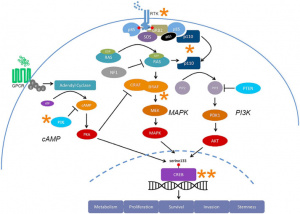
Figure 1: This image shows the interaction between the three key signaling pathways in glioblastoma. When receptors, RTKs and GPCRs, are activated, they initiate signaling that controls cell survival and proliferation. The MAPK pathway and PI3K pathway promote tumor growth, while the cAMP pathway has both inhibitory and regulatory effects. Cross-talk between these pathways enables signaling adaptability, contributing to therapeutic resistance seen in glioblastoma. All three pathways converge on the transcription factor CREB, which controls gene expression of processes like metabolism and survival. The orange stars show potential intervention points targeting the pathway or convergence points.
New Target?
Instead of targeting individual pathways, research has focused on convergence points where multiple signals meet. One main point is the protein CREB, which is a transcription factor that integrates signals from MAPK, PI3K, and cAMP pathways to regulate genes involved in cell growth, survival, and invasion [3].
But if CREB is inhibited, many of the cancer promoting genes are also inhibited. This provides a route for how future treatments might improve. Scientists are exploring using combination therapies to target both PI3K and MAPK pathways, drugs that restore cAMP signaling, and targeting CREB in hopes of better glioblastoma outcomes[4].
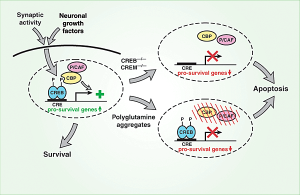
Figure 2: CREB-mediated gene expression promotes cell survival and proliferation, making it contribute to cancer resilience, especially in glioblastoma. CREB inhibitors lead to reduced cell survival and increased apoptosis. [5]
Conclusion
Therefore, these treatments would make it more difficult for the tumor to survive and grow. However, drug resistance, toxicity, and the difficulty of crossing the blood-brain barrier remain issues in treatment development.
Glioblastoma is a devastating form of cancer, which currently feels impossible to overcome. It behaves like a dynamic system that constantly adapts in response to treatment. As researchers discover more about its growth, development, and targeting the points where signaling converge, there will be more hopeful outcomes for treatment.
References
[1] Hong J, Wu Y, Li M. (2025). cAMP response element–binding protein: A credible cancer drug target. The Journal of Pharmacology and Experimental Therapeutics; 392
[2] Medical Treatment in Germany. (2026). Treatment for Glioblastoma. Treatment in Germany. https://treatmentingermany.de/blog-details/treatment-for-glioblastoma-full-guide-new-and-standard-treatment
[3] Xie, F., Li, B. X., Kassenbrock, A., Xue, C., Wang, X., Qian, D. Z., Sears, R. C., & Xiao, X. (2015). Identification of a Potent Inhibitor of CREB-Mediated Gene Transcription with Efficacious in Vivo Anticancer Activity. Journal of medicinal chemistry, 58(12), 5075–5087. https://doi.org/10.1021/acs.jmedchem.5b00468
[4] Sapio, L., Salzillo, A., Ragone, A., Illiano, M., Spina, A., & Naviglio, S. (2020). Targeting CREB in Cancer Therapy: A Key Candidate or One of Many? An Update. Cancers, 12(11), 3166. https://doi.org/10.3390/cancers12113166
[5] Dawson, T., Ginty, D. CREB family transcription factors inhibit neuronal suicide. Nat Med 8, 450–451 (2002). https://doi.org/10.1038/nm0502-450
