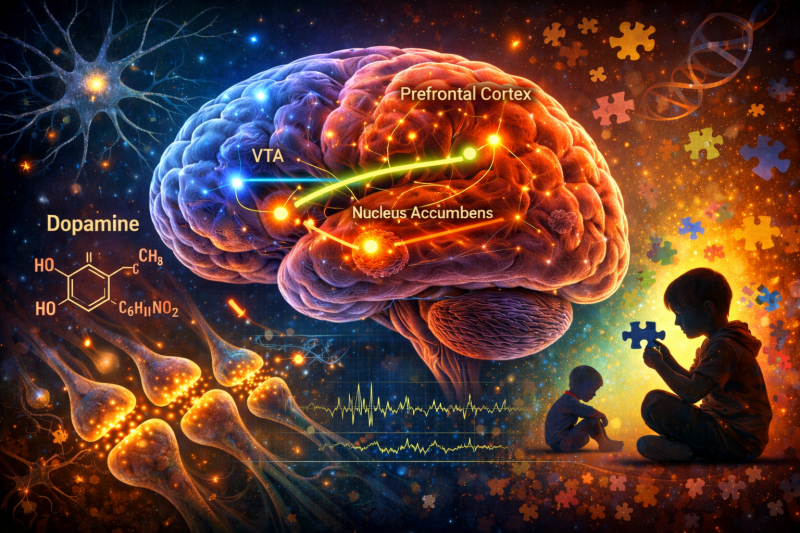
Dopamine is a neurotransmitter that plays a central role in motivation, learning, cognition, and movement. With increasing research summarized in the article by DiCarlo and Wallace, disruptions in dopamine signaling are thought to contribute to the symptoms seen in Autism Spectrum Disorder (ASD). ASD is highly complex and influenced by over 1,000 genes, so this paper focused on the link between dopamine dysfunction and the specific subtype of ASD that shows comorbidity with Attention Deficit Hyperactivity Disorder (ADHD). Since dopamine regulates reward processing, motivation, cognition, and motor control, abnormalities in dopaminergic circuits may alter how individuals with ASD experience social rewards, process information, and regulate behavior.[1]
Dopamine Production in the Brain:
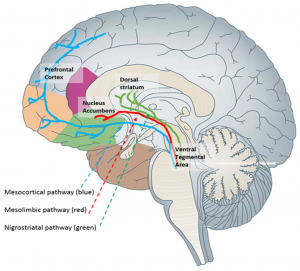
Most dopamine in the brain originates from two regions in the midbrain: the Ventral Tegmental Area (VTA) and the Substantia Nigra (SN). The VTA is the primary source of dopaminergic neurons and is involved in reward processing and motivation. These neurons increase their firing after rewarding experiences, helping the brain associate certain behaviors with positive outcomes, thus forming habits.[2] The substantia nigra, particularly the pars compacta region, also produces dopamine, but its major function is motor control.[3] From these areas, dopamine interacts with other regions of the brain through several key signaling pathways.
Dopamine Pathways in the Brain:
One of the most important dopamine circuits discussed in relation to autism is the mesolimbic pathway. This pathway originates in the VTA and spans to various structures such as the nucleus accumbens, amygdala, and hippocampus. The mesolimbic pathway is responsible for reward processing and reinforcement learning. It does so by strengthening connections between certain behaviors and positive outcomes.[4] The review article highlights that disruptions in dopamine signaling within this pathway may affect how rewarding social interactions feel for individuals with autism.[5]
Another pathway that originates from the VTA is the mesocortical pathway. This circuit reaches the prefrontal cortex and is involved in cognitive functions such as attention, working memory, decision-making, and impulse control.[6] In ASD, these functions are often altered. The paper suggests that disruptions in dopamine signaling within the mesocortical pathway may contribute to cognitive differences associated with ASD, including challenges in adapting to new information, maintaining attention, or regulating behavior.[7] Because the prefrontal cortex is critical for complex decision-making, even small changes in dopamine signaling in this pathway could influence how individuals process and respond to environmental stimuli.
The nigrostriatal pathway is the third major dopaminergic circuit. This pathway originates in the substantia nigra and projects to the dorsal striatum. Dopamine signaling along this pathway ensures smooth and controlled voluntary motor activity. Dysfunction of the nigrostriatal pathway is most famously associated with Parkinson’s Disease, where dopamine dysregulation leads to tremors and slowed movement.[8] However, dopamine abnormalities in this pathway may also be relevant to ASD.
Source of Photo: Theory of Addiction | Encyclopedia MDPI
Final Thoughts:
Together, these dopamine pathways illustrate how a single neurotransmitter can influence a wide range of behaviors depending on where it acts in the brain. The review article argues that examining these circuits and the role of dopamine may help researchers better understand the biological diversity within autism. By identifying specific patterns of dopaminergic dysfunction, scientists may eventually be able to classify specific subtypes of ASD and develop more targeted treatments.
Acknowledgments:
Feature Image created by me using AI generation
[1] Gabriella E. DiCarlo and Mark T. Wallace, “Modeling Dopamine Dysfunction in Autism Spectrum Disorder: From Invertebrates to Vertebrates,” Neuroscience & Biobehavioral Reviews 133 (February 2022): 104494, https://doi.org/10.1016/j.neubiorev.2021.12.017.
[2] “Ventral Tegmental Area: Location and Core Functions,” Biology Insights, July 24, 2025, https://biologyinsights.com/ventral-tegmental-area-location-and-core-functions/.
[3] “Substantia Nigra (SN): What It Is, Function & Anatomy,” Cleveland Clinic, accessed March 9, 2026, https://my.clevelandclinic.org/health/body/23010-substantia-nigra-sn.
[4] “Dopamine Chart: Pathways, Receptors, and Role in Brain,” Biology Insights, April 29, 2025, https://biologyinsights.com/dopamine-chart-pathways-receptors-and-role-in-brain/.
[5] DiCarlo and Wallace, “Modeling Dopamine Dysfunction in Autism Spectrum Disorder.”
[6] Biology Insights, “Dopamine Chart.”
[7] DiCarlo and Wallace, “Modeling Dopamine Dysfunction in Autism Spectrum Disorder.”
[8] Biology Insights, “Dopamine Chart.”
