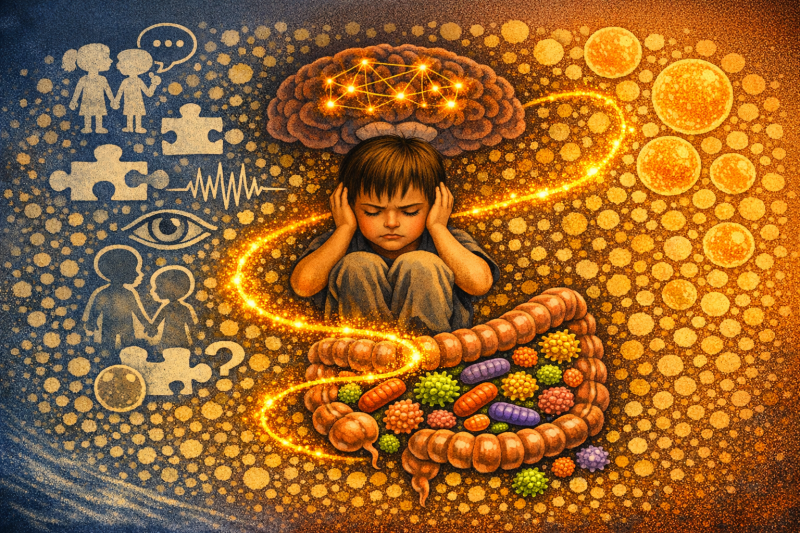
Imagine the brain as the body’s control center, constantly processing signals that shape how we think, feel, and behave. For a long time, it was believed that these signals were controlled almost entirely within the brain itself. But new research suggests that something much smaller, like microbes living in the gut, may also influence how the brain communicates. These discoveries are changing how scientists think about brain development and the signaling systems that shape behavior.
Dopamine and the Brain in Autism
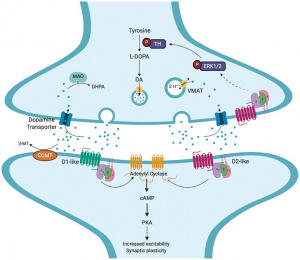
Autism Spectrum Disorder (ASD) is a neurodevelopmental condition that affects communication, social interaction, and patterns of behavior. Scientists now understand that autism does not have a single biological cause. Instead, hundreds of different genetic and environmental factors can influence how the brain develops, meaning that ASD likely involves several different biological pathways rather than a single mechanism. One system researchers are increasingly interested in is the brain’s dopamine signaling system and how it impacts ASD [1].
Dopamine is a neurotransmitter that helps regulate motivation, learning, and reward. It plays a major role in how the brain determines what experiences are rewarding and which behaviors should be repeated. Dopamine signaling is especially important in brain regions involved in the reward system, such as the basal ganglia and striatum, which help guide learning and motivation. When dopamine signals function normally, they help individuals learn from rewarding experiences and motivate behaviors such as goal-directed actions and social interaction.
Research suggests that changes in dopamine signaling may contribute to some of the behavioral changes seen in ASD. Rather than proposing that dopamine alone causes autism, scientists suggest that dopamine dysfunction may represent a subtype within the autism spectrum. Genetic studies have identified mutations in proteins involved in dopamine signaling, including the dopamine transporter that helps regulate dopamine levels at synapses. Brain imaging also shows differences in dopamine circuits in the striatum and basal ganglia, which were discussed earlier as they help regulate reward processing and repetitive behaviors. Since dopamine plays a large role in motivation and learning, disruptions in this system could influence how the brain processes rewards, which can affect social motivation, attention, and repetitive behavioral patterns seen in individuals with ASD [1].
The Gut Microbiome
In years of research, scientists have discovered that the brain does not work in isolation. Instead, it constantly communicates with other systems in the body through networks such as the Gut-Brain Axis. This bidirectional communication system links the brain and digestive system through neural, immune, and metabolic signaling [2]. A major part of this system is the gut microbiome, the community of trillions of microorganisms that live in the digestive tract.
Research has found that many individuals with ASD have different gut microbial communities compared to neurotypical individuals. These differences often include reduced microbial diversity, lower levels of beneficial bacteria like Bifidobacterium and Prevotella, and higher levels of bacteria associated with inflammation, including Clostridium and Klebsiella. Some studies suggest that the microbiome differences can appear early in life, even before the behavioral symptoms of autism are fully expressed. This has led researchers to look at whether changes in the gut microbiome can influence brain development [3].
Gut microbes can affect the brain in several ways. They produce molecules known as microbial metabolites, including short-chain fatty acids (SCFAs), which help in immune responses, maintain the intestinal barrier, and influence brain signaling. Changes in these metabolites, particularly lower levels of butyrate, which helps protect the intestinal barrier, have been seen in individuals with ASD [4]. Gut microbes also influence the metabolism of tryptophan, an amino acid that helps in making neurotransmitters such as serotonin [5]. Also, imbalances in the microbiome may increase intestinal permeability (also known as “leaky gut”) and trigger immune responses that release inflammation molecules, which researchers think could influence brain development and signaling [3] .
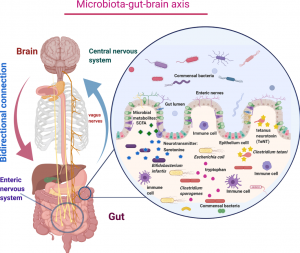
Understanding how the gut microbiome interacts with the brain may help researchers better understand the biological complexity of ASD. Because gut microbes can influence immune signaling, metabolic pathways, and neurotransmitter systems, including those involved in reward and motivation, changes in the microbiome could potentially affect brain circuits related to behavior. Scientists are also interested in the fact that the microbiome is modifiable. Unlike many genetic factors, gut bacteria can change in response to diet, environment, and medical treatments.
For this reason, researchers are looking into whether microbiome-based approaches such as dietary changes, probiotics, or fecal microbiota transplantation could help improve the gastrointestinal symptoms and possibly influence some behavioral outcomes in individuals with ASD [3]. This area of research is still developing but studying the brain and the microbiome together gives new insight into how different systems in the body interact in ASD and develop future treatment options. To learn more about the various treatment options and the research going into it, click here.
References
[1] G. E. DiCarlo and M. T. Wallace, “Modeling dopamine dysfunction in autism spectrum disorder: From invertebrates to vertebrates,” Neuroscience & Biobehavioral Reviews, vol. 133, p. 104494, Feb. 2022, doi: https://doi.org/10.1016/j.neubiorev.2021.12.017.
[2] M. A. Taniya et al., “Role of Gut Microbiome in Autism Spectrum Disorder and Its Therapeutic Regulation,” Frontiers in Cellular and Infection Microbiology, vol. 12, p. 915701, Jul. 2022, doi: https://doi.org/10.3389/fcimb.2022.915701.
[3] Y. Wan, Q. Su, and S. C. Ng, “New insights on gut microbiome and autism,” Trends in Molecular Medicine, Jul. 2024, doi: https://doi.org/10.1016/j.molmed.2024.06.010.
[4] E. Młynarska et al., “The Gut–Brain–Microbiota Connection and Its Role in Autism Spectrum Disorders,” Nutrients, vol. 17, no. 7, p. 1135, Mar. 2025, doi: https://doi.org/10.3390/nu17071135.
[5] “Kids with autism show altered gut microbiome-brain interactions, researchers find,” Uclahealth.org, Jun. 18, 2025. https://www.uclahealth.org/news/article/kids-with-autism-gut-microbiome-brain
[6] M. A. Taniya et al., “Role of Gut Microbiome in Autism Spectrum Disorder and Its Therapeutic Regulation,” Frontiers in Cellular and Infection Microbiology, vol. 12, p. 915701, Jul. 2022, doi: https://doi.org/10.3389/fcimb.2022.915701.
Featured image created by Julia Wolf and Microsoft CoPilot.
