Introduction: The Signals That Shape Us
Every day, we are guided by invisible signals that tell us what matters. A smile from a friend, a good grade, even the satisfaction of finishing a task – these experiences feel meaningful because our brain marks them as worth it.
But what if those signals were quieter? Or different?
Autism Spectrum Disorder (ASD) is often described through behavior – differences in social interaction, communication, and patterns of repetitive actions. Yet beneath these outward traits lies something deeper: a brain that may be processing value and reward in a fundamentally different way. At the center of this idea is dopamine, a neurotransmitter that does far more than simply make us feel good.
Dopamine: More Than a “Feel-Good” Chemical
Dopamine is often misunderstood as the brain’s “pleasure chemical,” but its real role is more precise. It acts as a kind of internal currency, helping the brain decide what is worth attention, effort, and repetition. When dopamine is released, especially in pathways connecting areas like the ventral tegmental area and the nucleus accumbens, it sends a powerful message: this matters—remember it, seek it again.
This system shapes how we learn from our environment, how we stay motivated, and how we engage with others. It quietly influences everything from studying for an exam to forming friendships.
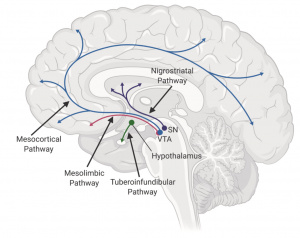 Figure 1(left): Dopaminergic pathways connecting key brain regions involved in reward and motivation. [1]
Autism: A Spectrum, Not a Single Story
One of the most important things to understand about ASD is that it is not caused by a single gene, pathway, or brain difference. Instead, it represents a wide spectrum of neurobiological variations. Researchers now recognize that there may be multiple subtypes of ASD, each shaped by different underlying mechanisms. [1]
Among these possibilities, dopamine dysfunction stands out as a compelling explanation for some individuals. Since dopamine is central to reward processing and behavioral learning—both of which are often altered in ASD – it offers a way to connect brain chemistry with lived experience.
When the Reward System Shifts
In a typical brain, social interactions are naturally rewarding. Eye contact, shared laughter, or conversation can trigger dopamine release, reinforcing those behaviors over time. However, in some individuals with ASD, these same social cues may not produce the same internal response.
If social interaction does not feel rewarding, the motivation to seek it out may be reduced—not because of disinterest, but because the brain is assigning value differently. At the same time, predictable and repetitive behaviors may provide a more reliable or satisfying signal, making them more appealing.
This perspective helps reframe common features of ASD. Reduced social engagement and repetitive actions are not simply deficits; they may reflect a brain that is responding to a different set of internal rewards. As the research suggests, disruptions in dopamine signaling can directly affect reward processing and learning patterns in ASD.[1]
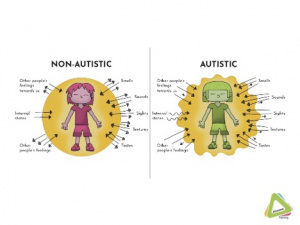 Figure 2: Differences in dopamine signaling may shape how social interactions and repetitive behaviors are experienced in autism.[2]
Repetition, Motivation, and Control
Dopamine also plays a key role in shaping habits and repetitive behaviors. When dopamine signaling is altered, the balance between flexible behavior and repetition can shift. Interestingly, this is not unique to autism. In conditions like Parkinson’s disease, where dopamine levels are medically adjusted, individuals can develop intense, repetitive behaviors—highlighting how powerful this system is in driving what we do again and again.
This connection suggests that repetition in ASD may not simply be a behavioral trait, but a reflection of deeper neurochemical patterns influencing motivation and control.
Conclusion: Rethinking Behavior Through the Brain
Understanding autism through the lens of dopamine invites a shift in perspective. Instead of asking why certain behaviors occur, we begin to ask how the brain is assigning value to the world.
If dopamine signals are altered, then the meaning of everyday experiences changes. Social cues may feel less compelling, while structured patterns may feel more grounding. This is not a failure of the system, but a difference in how it operates.
Recognizing these differences is important, not only for understanding ASD, but for shaping more thoughtful and personalized approaches to support. Because ultimately, behavior is not just what we see—it is the reflection of how the brain experiences the world.
Bibliography
[1]
E. DiCarlo and M. T. Wallace, “Modeling dopamine dysfunction in autism spectrum disorder: From invertebrates to vertebrates,” Neuroscience & Biobehavioral Reviews, vol. 133, p. 104494, Feb. 2022, doi: 10.1016/j.neubiorev.2021.12.017.
[2]
“What is autism? | AUsome Training | Autism explained by Autistics.” Accessed: May 05, 2026. [Online]. Available: https://ausometraining.com/what-is-autism/
[Feature image]
“Is There an Autism Epidemic? | Johns Hopkins | Bloomberg School of Public Health.” Accessed: May 05, 2026. [Online]. Available: https://publichealth.jhu.edu/2025/is-there-an-autism-epidemic
