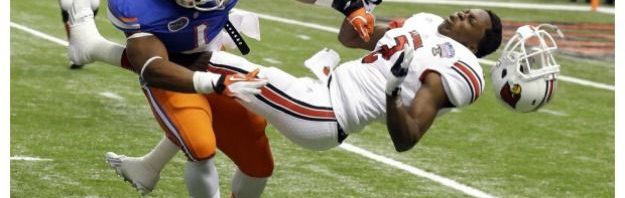
Anyone who’s a sports fan (or anyone who’s in touch with the news, for that matter) has heard of the current concussion issue in today’s sports. Whether it be football, boxing, or any other sport, there has been a dramatic increase in media attention towards brain injury. And that’s a good thing. It has now been demonstrated on multiple scientific platforms that repeated trauma to the brain can have severe long-term effects on mental health and stability. Most notably is Dr. Bennet Omalu’s findings in ex-NFL players’ brains after years of repeated concussions. Chronic traumatic encephalopathy, or CTE more commonly (pictured below), is the disease Dr. Omalu discovered in these brains, and it has been linked to the death of numerous players of various ages. This issue received so much attention that Dr. Omalu’s story was developed into a movie starring one of Hollywood’s biggest names Will Smith. So clearly, the safety of football players’ brains is a hot topic. The question then becomes, what can we do?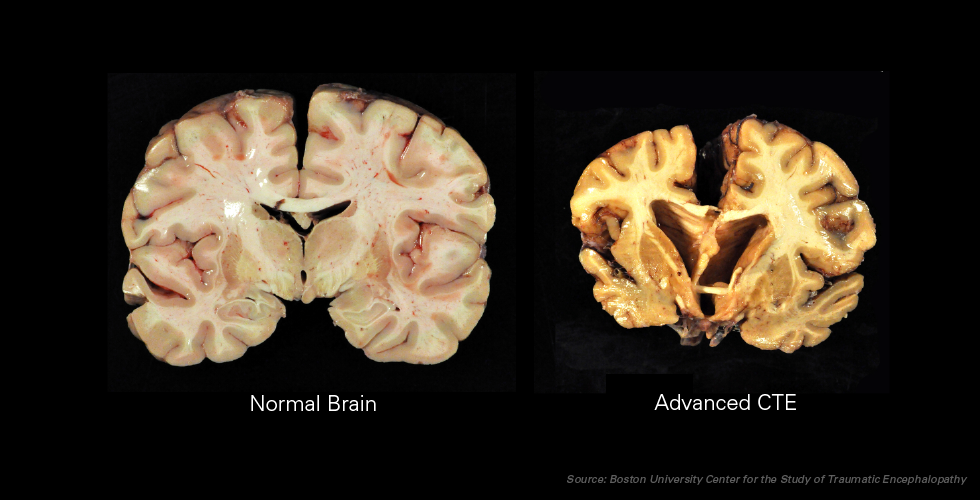
The answer is not to ban football. The answer will never be to ban football. Can you imagine America without the NFL? There would be extreme chaos on Sundays when football fans sit down to watch TV without knowing what to watch. However, there is a different approach the NFL and, really, all of football can take – change the game. Not even drastically, just enough to save the brains of the players. There have been some interesting ideas put forward since the dawning of the concussion issue, and I’m going to highlight two possible paths of change football can take: changing the style of play and changing the equipment players use.
Beginning with the idea of changing the style of play, I believe more issues are presented taking this route. I mean, changing a sport in today’s culture isn’t easy to begin with (as the NFL has realized), but to change the style of play altogether seems nearly impossible. However, I think an interesting route to take begins with the youth. When I see a young kid strap on pads and a helmet for the first time, I can see it in his eye that all he wants to do is hit another object, whatever that object may be. I don’t blame him either – he’s fully protected and has nothing to lose, right? But what if instead of having the luxury at that early age of being fully protected and given the opportunity to do basically whatever he wants with his  s body on the football field, he has to be more careful? What if, instead of ramming his head into the oncoming running back or linebacker, he has to think twice before doing so? What if (hear me out) he wasn’t wearing a helmet? It seems absurd, but think about it – the coaches are then given the opportunity to stress the importance of tackling form, not leading with the head, and looking out for your own safety at the same time. The game is played at such a slow pace compared to when the players get older that I think this would be an excellent chance to teach the younger kids how to properly and safely play the game. Then, when they reach the high school level, they’re given the helmet as simply a safety device instead of the weapon it is currently. Yes, it’s a risky idea and probably will not happen at this point in the evolution of modern football, but I think it’s worth thinking about.
The second option is to modify the equipment players use, and I think this route is much more practical. Already, the NFL is engineering new pads and helmets to save its players and their brains, but with the recent news of CTE emerging dramatically out of nowhere, I believe drastic equipment changes must be made. One really interesting idea is this helmet (pictured below), which is known as the “Inside Out Helmet.” Seriously, watch the attached video – it’s really cool what these engineers are doing to protect the brains of football players.

Here’s the deal with a helmet like that, however – concussions are going to happen. Always. As long as football is played, a wide receiver will run a slant across the middle of the field, get absolutely lit up by a linebacker, and end up with a concussion. Even if the tackle was perfectly clean and even if he was wearing an extremely protective helmet. People can’t get enough of those big hits. But as long as this player does not return to the game and gets adequate rest before returning to play, his brain should be fine in the long term. The players that are at most risk for developing long term disease such as CTE, actually, are the linemen. The guys that don’t get the attention or the spotlight. Their brains are more at risk because of the constant impact their heads take every play of every game. Although the impacts of these “sub-concussive” hits aren’t nearly as severe as the hits taken by players such as the aforementioned wide receiver, they are constant. They are chronic – thus, the name “chronic traumatic encephalopathy.” Therefore, with the implementation of an advanced helmet such as the Inside Out Helmet, I believe their brains will be significantly more protected, putting the linemen in far less risk of developing a serious disease down the road.
Whatever the case, it is clear football needs to change. Quickly. The issue of concussions and repeated brain trauma in players of all ages, especially in the NFL, is becoming so substantial that action must be taken right now. Don’t get me wrong, the NFL’s new concussion policy is a great first step and something that is undoubtedly necessary, but there needs to be more. There needs to be more protection, more education, and even more awareness. And I believe the two options I presented, although entirely speculative and absolutely unproven, could hold some weight in combatting this issue that our nation’s favorite sport faces.
A New NFL: Why Football Needs to Change