Feature Image Credit: Created by Jackline Peace Nanyonga using ChatGPT.
Why Do Some Stressful Memories Stay?
Have you ever wondered why your brain holds onto a stressful moment like a high-definition movie, while other memories just fade away? We know that stress can shape powerful memories by changing how the brain functions at a molecular level. These changes, especially in the hippocampus, help us adapt to future challenges.
However, not everyone responds to stress in the same way. Some people develop overwhelming, persistent memories, while others recover more easily. This raises an important question: what controls how strongly stress is encoded in the brain? Emerging research suggests that exercise, through its effects on GABA, may be a key piece of the puzzle.
How Stress Becomes Memory
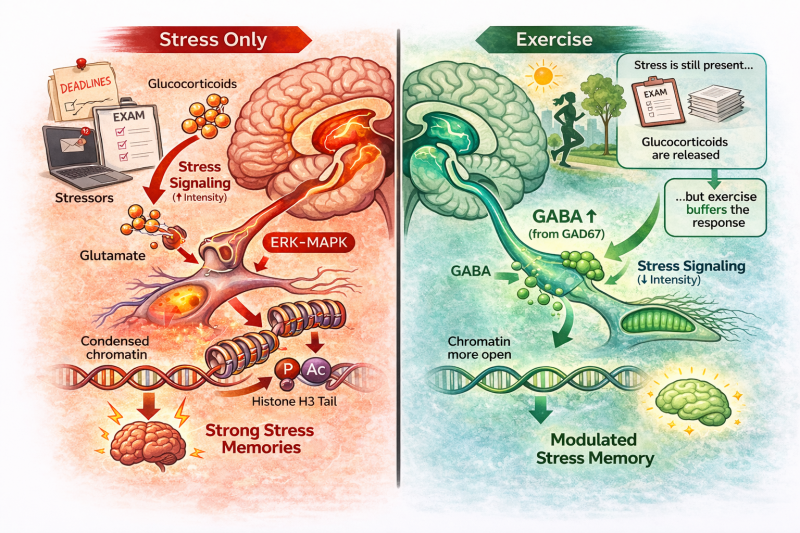
When we experience stress, the body releases glucocorticoid hormones (like cortisol), which travel to the brain and interact with regions involved in memory, particularly the hippocampus. At the same time, neural activity increases through pathways like theERK-MAPK signaling pathway.
These two systems – hormonal and neural – don’t act independently. Indeed, they interact to trigger a cascade of events inside neurons that ultimately leads to changes in gene expression. [1]
One of the key mechanisms involved is epigenetic modification. Think of it as your brain “bookmarking” its most stressful experiences so it can find them quickly later on. In this case, stress causes specific changes to histone proteins (such as H3S10p – K14ac), which open up sections of DNA and allow certain genes – like c-Fos and Erg-1 – to be expressed. [1]
These genes are critical for consolidating memory, essentially helping the brain store the stressful experience for the long term.
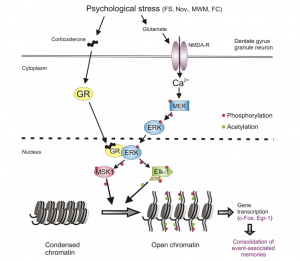
Figure 1(right): An image of how stress activates both glucocorticoid receptors and neural signaling pathways to drive gene expression and memory formation. [1]
Why Anxiety Changes the Outcome
Even though these mechanisms exist in everyone, their effects aren’t the same across individuals. One major factor that shapes this response is anxiety level, which is closely tied to the neurotransmitter GABA.
GABA acts as the brain’s primary inhibitory signal—it helps keep neural activity in check. When GABA levels are high, neurons are less likely to become overactive. When GABA levels are low, the brain becomes more excitable and more reactive to stress.
The paper highlights that GABAergic signaling plays a critical role in regulating how strongly stress activates the hippocampus, particularly in the dentate gyrus. [1]
This means that:
- Lower GABA activity → stronger stress signaling → stronger memory formation.
- Higher GABA activity → reduced stress signaling → more controlled memory encoding.
This helps explain why individuals with higher anxiety may foirm stringer, more persistent stress-related memories.
Exercise and GABA: A Protective Mechanism
This is where exercise comes in and where things get really interesting.
The paper reports that long-term voluntary exercise increases the expression of GAD67, an enzyme responsible for synthesizing GABA. [1] In other words, exercise may actually increase the brain’s ability to produce GABA.
This shift has important downstream effects. Increased GABA strengthens inhibitory control in the hippocampus, which reduces neuronal excitability. As a result, key stress-related signaling pathways – like ERK-MAPK – are less strongly activated.
Studies in a paper by Reul, 2014 showed that exercised animals had:
- Reduced activation of ERK-MAPK signaling
- Lower levels of stress-induced gene expression (like c-Fos)
- A dampened molecular response to stress [2]
What this suggests is that exercise doesn’t stop stress from occurring, but it changes how intensely the brain responds to it.
Why This Matters
These findings go beyond basic neuroscience – they have real implications for mental health. Conditions like PTSD are often linked to overactive stress responses and persistent memory formation. If exercise can increase GABA levels and reduce the intensity of these processes, it may serve as a powerful, accessible way to build resilience.
More broadly, this research highlights something important: our experiences don’t just shape our minds psychologically – the reshape them biologically as well. And through behavior like exercise, we may have more control over that process than we think.
Bibliography
[1]
- M. H. M. Reul, “Making Memories of Stressful Events: A Journey Along Epigenetic, Gene Transcription, and Signaling Pathways,” Front. Psychiatry, vol. 5, 2014, doi: 10.3389/fpsyt.2014.00005.
[2]
“Neuroscience Pinpoints Unique Way Exercise Fights Depression | Psychology Today.” Accessed: Apr. 14, 2026. [Online]. Available: https://www.psychologytoday.com/us/blog/the-athletes-way/201602/neuroscience-pinpoints-unique-way-exercise-fights-depression
