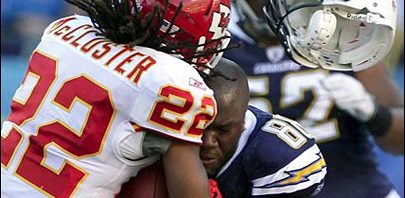
Concussions: Science Says They’re a Big Deal

When I visited the movie theatre last fall to see Concussion, I expected to receive a dose of entertainment, but I instead received a dose of reality. It told a true story about a forensic pathologist, Bennet Omahu, handles the autopsy of Mike Webster, former NFL player for the Pittsburgh Steelers. After close examination of the NFL player’s brain, he discovers that there is evidence of severe brain damage, which contrasts with the individual’s otherwise healthy body, so Omahu concludes that the death is due to chronic blows to the head, a disorder he identifies as chronic traumatic encephalopathy (CTE).
Now this movie contains action, drama, romance, and thrill, but it,arguably, more importantly sheds light on the dangerous effects of concussions.
According to WebMD, a concussion is a type of traumatic brain injury caused by a blow to the head or body, a hard fall, or basically anything else that shakes the brain inside the skull. Concussions are a unique injury, because the damage cannot necessarily be obvious. A concussion causes normal functions in the brain to malfunction. The people most susceptible to getting a concussion are athletes, with football, boxing, and soccer having higher rates of concussions.
Symptoms of concussion include headache, nausea, fatigue, memory problems, sleep disturbances, and mood dysregulation, according to the Brain Injury Research Institute. In many cases signs of a concussion appear right away, but they may not appear until a couple days later. This makes diagnosing a concussion difficult, and it leads to additional risks if it is not treated immediately post-impact.
More research on the long-term effects of concussions has investigated the dangers of repeated concussions than the lasting complications of a single concussion. Research has concluded that repeated concussions are especially damaging in regards to long-term health. Some long-term consequences of repeated concussions include

  • Cognitive impairment
  • Anxiety disorders (PTSD)
  • Learning interference (spatial learning)
  • Depression
  • Motor dysfunction
  • Memory deficits
  • Alzheimer’s Disease
  • Mood Instability

When I was watching Concussion, I was amazed to see how seriously Webster’s life fell apart. We was pictured suffering from self-mutilation and homelessness, and he ended up dying alone. Realizing that this is the experience for many people due to CTE makes the severity of concussions seem much more real.
This understanding directed my curiosity to learn more about concussions and how they affect the brain. According to a 2014 article in Neurosurgery, brain injury leads to damaged axons (part of the neuron that transmits a signal to another neuron).
FullSizeRender
The axons get stretched so that calcium and sodium ions enter into the cell, and this leads to excess excitatory neurotransmission. The mitochondria goes into hypermetabolism to try to restore the balance and ultimately goes into hypometabolism because it has entered an energy crisis. Concussion also leads to an accumulation of abnormal proteins in the brain.
The Sports Concussion Institute has developed a graduated “Return to Play” protocol that details the rehabilitation stages a player must go through to return to playing their sport after a concussion. This management plan has been challenged by the “Return to Learn” protocol, which insists that players must be reintegrated to academics before athletics after a concussion, according to the Brain Injury Association of America.
It is advancements like these that will help individuals properly heal after a concussion before being back on the field with the risk of receiving another one.
I can’t imagine how hard it would be to get a concussion as a high school athlete. I would want to keep playing, no doubt. Protecting my brain for the sake of my long-term health wouldn’t be the first thing on my mind. Then to think of a professional athlete who might have devoted teammates and millions of fans depending on him or her, that would be even trickier.
As a culture, we need to balance our passion for competition with concern for future health. This will be a step in the right direction of enhancing lifelong health and reducing diseases that get in the way.
Return-to-Play and Second Impacts

In the past, there has been little research done on concussions and what is actually going on in the brain, until recently. Neuroscience research has grown and with that the research on concussion has taken a keen interest. The importance of finding the effect concussions have on the brain is a major contributing factor on how treatment should be done and how the Return to Play (RTP) protocols should be handled in order to properly heal and avoid a secondary impact.

                The standard misperception on what happens as a result of a concussion is neuronal (cell) death occurs which causes the symptoms. However, what actually goes on in the brain is a change in the biological pathway. What is thought to occur is axonal damage of the neurons results in an influx of sodium and calcium and efflux of potassium. Compensation occurs by way of oxidative stress within the mitochondria and an ATP need increase causes hyper-metabolism. Axonal transport is affected as well. Later, hypometabolism occurs. This is where the problems with most RTP protocols are. A longer duration of time is needed for this phase of the injury to heal. It is essential to avoid a secondary impact during hypo-metabolism. The brain is low on energy already and a second impact would cause it to go into hyper-metabolism again. Lastly, accumulation of abnormal proteins occurs along with inflammation.

                In order to avoid concussions, a change needs to be made. Within secondary school, a change can be made in the Return-To-Play (RTP) protocol with an addition of Return-To-Learn (RTL). In California, there are schools which implement completion of the RTL program before starting the RTP. This allows the student to catch up with school work that has been missed while they had their concussion and lessens the chance of the individual receiving a secondary impact before completely healed.  Another change that can be made is the awareness of concussion occurrence at a younger age and education to coaches of primary school sports. Adults’ and parents’ awareness of concussions are shown within a high school, but often it is not thought about with elementary or middle school.

http://news.discovery.com/human/health/will-kids-be-banned-from-football-130212.htm

                One problem faced when dealing with concussions is the awareness of the severity that can result in no matter the age, how hard the impact, and if not healed properly. Unmyelinated neurons are more susceptible to injury, children are growing and have a higher percentage of unmyelinated neurons and therefore, may be more prone to concussions. Although children may heal faster, it is important to be aware children can give and get concussions as well. Another problem faced is the thought that it must be a hard impact in order to receive a concussion. This is not true; individuals can receive multiple small impacts and get a concussion. Lastly, if the concussion is not healed properly and a second impact occurs, it will result in a worse injury than initially. In other words, it is better to sit out and wait to be healed than get in the game too early and set yourself further back.

Concussions: Not Just an Excuse to Miss School

Concussions are a not well-understood invisible injury that has no boundaries on who it can affect. A concussion may be caused by a blow, bump or jolt to the head, or by any fall or hit that jars the brain. This invisible injury disrupts the way the brain normally works by affecting mental stamina, as the brain must work longer and harder even to complete simple tasks.
Recently, researchers have figured out the neurochemical cascade that occurs in the brain after a concussion:

  1. There is depolarization in the cell and release of high amounts of excitatory neurotransmittors.
  2. Potassium is brought out the cells and Calcium is rushed in causing an imbalance (Hypermetabolism).
  3. Increased activity of ATPase and a decreased production of ATP (Energy Crisis).
  4. Axolemmal disruption, axonal swelling and possible apoptosis.
  5. To much stored Calcium, no ATP for energy, no activity Hypometabolism).

This cascade shows us why patients are very tired, but also that sleep is very important to a concussed person. The Hypometabolism stage shows us why second impact syndrome is so bad, because if you receive another concussion in this state there are no chemicals of energy left to start this cascade over again.
Concussions are serious brain injuries that have a significant influence on the brain’s ability to function at its normal capacity. The key to recovery from a concussion is both physical and mental rest, followed by a gradual progression back to activity, both in athletics and in the classroom.
Scan 2016-11-6 16.21.14
Concussion symptoms can have a significant impact on classroom learning and schoolwork. Physical symptoms may interfere with the student’s ability to focus and concentrate, while cognitive symptoms may impact the ability of the student to learn, memorize and process information, as well as keep track of assignments and tests. Struggles with school work may worsen the frustration, nervousness and irritability that were originally caused by changes in brain chemistry.
No two concussions are exactly the same so individualized treatment is necessary. Developing brains are highly variable; so one student’s symptoms may be completely different, and therefore, some students may need to miss school to help heal for varying amounts of time, while others will be able to continue their work with some accommodations.
Nationwide Children’s has come up with a 5 step plan for teachers to understand when helping a concussed student through school work.

  1. No School: Rest with no activity, screen time and healthy meals are key to begin the healing process
  2. Half-day Attendance with Accommodations: Accommodations may be limited homework and reschedule tests.
  3. Full-day Attendance with Accommodations: Accommodations may be breaks in between classes.
  4. Full-day Attendance, No Accommodations. No activity is allowed yet, full class load is allowed.
  5. Full-day and Extracurricular Activities.

A concussed student needs to hear from educators that they understand what a concussion is and what the student may be experiencing. The student needs reassurance that he or she will not fail classes because of missed school days and homework. This sympathy, understanding and consistency from all parties involved will help to decrease stress, and in turn, help with recovery.

We Need to Let People Heal From Concussions

Concussions can cause long lasting neurological problems. In extreme cases head trauma (even sub-concussive) can lead to chronic traumatic encephalopathy. This neurodegenerative disease has horrible symptoms, memory loss, disorientation, violence, social issues, depression, even suicide.
When I started doing research on CTE this week I was shocked. I saw story after story of successful, motivated people falling victim to this horrible disease. It would their lives. All because of a history of concussions.
So what can we do to prevent brain injuries? We could stop doing activities that result in concussions.
Sadly, that is impossible. Even if it was possible to convince people to stop playing contact sports like football, wrestling and even soccer; car crashes and other accidents would still exist and people would still get head trauma.
Since it is impossible to completely prevent concussions. We need to do a better job treating them and educating people on the importance of recovering from concussions.
Currently there is no conclusive biomarker such as a blood test that can tell if someone has a concussion. However, it likely that this will be possible in the future. For now, medical professions must diagnose concussions by symptoms described by the patients.
This system has a problem. Athletes and students with concussions face pressure to keep up in school and return to playing sports as soon as possible. This is problematic because it doesn’t give them time to heal. Ideally after a concussion a person should not just abstain from TV and sports but should really limit reading, intense problem solving, and studying. Sadly, this is not feasible for the vast majority people.
We need to prioritize our health and let people recover from concussions to prevent permanent neurological damage. Having people try to continue normal school or work activities with a concussion is like asking someone with a broken ankle to go run a mile. It will just make the healing process more painful and difficult and may end up making the injury worse.
Another reason to let people heal is second impact syndrome. This condition is caused by multiple concussions occurring in a short period of time. It can cause permanent disability or even death.
We need to let people recover after concussions and be more cautious in letting people return to normal activities. If people can’t avoid getting concussions we need to let them heal, or there could be permanent neurological consequences.

Concussions: Should We Take Them More Seriously?

As the world of science has expanded, concussions have begun to be understood more. Even when I was in high school, concussions were not that big of a deal. Now, concussions are treated with a lot more care, as they should be. It was until recently that I truly understood just how serious a concussion can be. Having had two concussions myself, I now realize I did not take them as serious as I should have.
Concussions are essentially a hard blow to the head. But, the underlying mechanisms that go on after the hit is what causes all of the symptoms such has headaches and nausea. At the molecular level, many non-specific depolarizations start to occur after an impact. As the neurons begin to fire, there is a release of excitatory neurotransmitters, which is followed by an efflux of potassium. Many ionic membrane pumps begin to go into overdrive, trying to retain homeostasis. This is coupled with an increase need for ATP due to the extra work of the ionic pumps. The cells are launched into hyperglycolysis as they try to keep up with the energy demands. After a concussion, the cell membranes also become “leaky” resulting in an increase of calcium inside of the cell. This also results in more action potentials, and contributes to the increased energy demand.
IMG_2939
Eventually, the energy demand becomes too much and results in a decrease in ATP production. This leads to a hypometabolism state, which is in my opinion, the key part to understand in a concussion. If an area of the brain is unable to produce the energy it needs in order to meet baseline needs, then the brain obviously needs to rest. This is why doctors recommend as much rest as possible immediately after a concussion. This includes: no sports, no screen time, and less school time.
Taking a physician seriously with all of their recommendations for a concussion can be difficult. How can a person just not go to school for a few days? The hypometabolism that results from a concussion needs rest in order to attain normal order again. The brain will not be able to rest as efficiently if a person is trying to listen to a lecture or do homework. Without the needed rest, the brain is more susceptible to a second concussion, which would result in going back to square one for recovery. This is why it is very important to take the recommended time to rest in order to allow a speedy recovery and to get back to normal everyday life.
After learning how important rest is for concussion recovery, I know that I did not take the needed care after I had mine. This can be scary, because I may have left my brain to be more susceptible to re-injury or possible some other effects later in life. So, my message to you: give your brain the rest it needs after you experience a concussion, that really is the best “medicine” for it.
 

Invisible Injuries in Football

One of the most popular sports in the United States is football. Kids will begin playing when they are in the fourth grade, even earlier in some cases. Athletes that play in the NFL have been involved in the sport for over 10 years.
Football is also the sport with the highest concussion rates. Since football players are playing this high contact sport for numerous years, it is no wonder why they receive so many head injuries. A lot of changes take place in the brain after a concussion.
We will return to the topic of football players after going over a brief description of the neurochemical changes occurring in the brain after a concussion.
The Neurochemistry
An article written by Christopher Giza and David Hovda in the journal of Neurosurgery explains some of the damage occurring to the brain when someone gets a concussion. The physical damage will lead to chemical imbalances in the brain.
When the brain hits the skull there is a significant amount of axonal damage done to the neurons. This makes the axons “leaky,” so there is more ionic flux. This will also disrupt axonal transport and render many neurons incapable of proper firing.
The cell will then use a lot of ATP to try and compensate for the extra stress on the cell. This excess use of ATP is called hyper metabolism. After the period of excess ATP use, the cells will enter into a phase of hypo metabolism.
During this phase the brain is still healing, and it is imperative that the concussed person continue to rest to aid the recovery process.
The Myth Surrounding Sleep
Since a concussion is a brain injury it can be difficult to heal because you cannot shut off your brain like you can put a cast on a broken bone. One of the best ways to recover from a concussion is to rest your brain, and this includes getting a lot of sleep.
Many people have heard the myth that if you get a concussion that you need to stay awake or you might slip into a coma. According to the Marshfield Clinic, it is actually a good thing to get some sleep after a brain injury.
It is still advised to see a doctor after getting a concussion to get a formal evaluation, but if a person can hold a conversation and seems okay the doctor will most likely clear then to get some rest. Just as someone would rest a broken arm, it is important to rest the brain as well.
Football Players
Avid viewers of football games know that there is usually a game every week, unless the team has a bye week. The average concussion cannot fully heal in this short time frame, so many players may be putting themselves at a greater risk by playing before their brain has healed.
It has been found that as a person gets more and more concussions the risk for permanent brain damage increases. The brain is even more vulnerable to further damage if it has not fully recovered from the first concussion.
All players are required to wear helmets during game play, but it is clearly not preventing concussions. There is currently research being done to try and develop new helmets that would better protect the brain.
Concussions are an invisible injury, so they might not seem as serious as they truly are. It is becoming increasingly more obvious that there needs to be more precautions taken by athletes and trainers to protect the brain.

The Real Cost of Addiction

Try and imagine a life where you felt you needed something more than food and shelter. Being an addict is one way that this could become a reality. The compulsion to get their drug of choice can become the most important thing for an addict, even if they are going hungry or lose their homes.
Not only is it expensive for the drug seeker, but this problem also affects the nation. It has been found that more than $700 billion dollars is spent annually to handle this social issue (National Institute on Drug Abuse, 2015).
The Impacts on Family
Addiction does not only affect the addict. The families of addicts may face significant problems while trying to help an addict. This disease can cause problems with a family’s mental and physical health, finances, and the family dynamics (National Council on Alcoholism and Drug Dependence, 2016).
Family life may be completely overtaken by this problem. Kids may go through scary experiences that addiction drawings make them worry about their parent. Spouses may wonder where all the money for food and bills has gone.

If steps are not taken to solve this disease, it can cause problems for a lifetime. To try and treat an addict there are various options, such as therapy. The use of medications is being investigated, but there needs to be more information about the disease before they can be produced.
The Neurochemistry of Addiction
Drug addicts will experience tolerance, sensitization, and dependence after prolonged use. Scott Philibin and colleagues explain how some of this occurs in an article in the journal of Frontiers in Neuroanatomy. The article explains that there are numerous areas of the brains that are affected by these drugs of abuse.
One of the main points that the researchers make is that drugs of abuse raise the amount of dopamine that is released, which makes the drug more addicting. There are many second messengers and kinases that can be affected as well, but it becomes very complicated at this molecular level.
The researchers of this article performed many experiments using mice to study addiction. One useful technique used was the extinction and reinstatement mouse model. The results from this specific experiment have led to knowledge about recovery and relapse of addicts.
Extinction-Reinstatement Model
For this experiment, mice are taught to self-administer some drug by pushing a lever. The mice will become addicted, and once they are the drug will be taken away. The mice will continue to push the lever, but they will not receive any drug.
This is the extinction phase where the learned association is taken away. Eventually the mice will reach a level of unresponsiveness, and this is when the reinstatement phase begins.
The mice will be given drug cues to see if they revert back to the drug-seeking behavior. If they do, then it is determined that they have relapsed.
Gass and Chandler reviewed a research article in the journal Frontiers in Psychiatry that details the use of this method. It was found that the use of pharmacological aids may help the addicted mice refrain from relapse.
Further research is still needed to find further evidence about the use of medications, but the combination of medicine and therapy could be one answer to helping addicts.

From a One-Time High to a Lifetime Prison: A Journey of Drug Addiction

Drug addiction brings certain images to mind – and they’re not exactly pretty. Strung out, passed out, bad teeth, bloodshot eyes, destroyed veins. It’s part of the stigma of society. Often, our first impression of someone with an addiction is that they got themselves into that situation. But is that always the case? Perhaps not, but whether we believe drug addiction is a result of choice or disease, one thing is clear; addiction is a problem.
How does it start?
They often say certain situations in life can be traced to a single decision. This, I believe, is very much the case with addiction. It is a choice that becomes an addiction.
Today, more than ever before, kids, young adults, really anyone, has greater and easier access to illicit drugs. This increased exposure makes it more difficult to resist temptation. In truth, I’d assume most addictions start out rather innocent. I find it difficult to believe that anyone ever sets out in life to become an addict. Initially, it’s all about the fix. A one-time fix. A one-time high. A temporary escape. But thanks to the damaging effects of such drugs on brain chemistry and physiology, that one-time escape can turn into a lifelong prison.
Even when the drugs don’t have highly addictive properties, a user is still at risk to be set up for addiction. Many dealers these days are lacing drugs with highly addictive substances such as Fentanil or Carfentanil, ensuring that all it takes is one hit and then a person is hooked. Besides this scary thought, the concept of gateway drugs is very much a real thing and not just something parent say to scare their kids off from using marijuana or drinking or smoking. Individuals that participate in this “gateway” drug use become accustomed to the experience of using a drug to feel better, and are more often to look to that same place in the future.
The Dark and Winding Road That Follows
Although it is true that many individuals may use an illicit drug once and not become addicted, for far too many that is not usually the case. In any regards, even if an individual does not become addicted after a one-time use, the effects of that one use can remain with them for years.
Locomotor sensitization can be a result of continued use as well as in some cases, one-time use, although sensitization increases with each successive use of a drug, so continued use presents greater risk. This progressive increase in sensitivity is supported by the alterations we observe in the neural mechanisms that mediate acute locomotor stimulant response. Not only do these mechanisms become increasingly sensitized with each successive drug administration, but this sensitization can remain for long periods of time, even after drug administrations have long ceased. For example, sensitization to classic stimulants such as cocaine, amphetamine, and morphine have been shown to persist for up to 3, 12, and 8 months respectively. These persistent neuroadaptive changes in sensitivity to abused drugs could be a potential explanation for why individuals may relapse even after longer periods of abstinence and presumed recovery.
Preventing the Point of No Return
It would seem that our best option in regards to drug addiction, would be to prevent exposure. While this seems a noble endeavor, it is not one that I see being highly successful. Accordingly, we must look for solutions to the problem elsewhere. Do we treat drug addiction with more drugs? As counterproductive as it may seem, some research shows that this can actually help to restore normal brain chemistry and may in fact be beneficial in some cases.
Perhaps, we can prevent these powerful “drug memories” – that lead to addiction – from forming, or take away the high associated with addiction, essentially taking away the pleasure of ever using to begin with.
These methods all have their own challenges, but seem like viable options to counter the problem of drug addiction, and hopefully, in the future, they can do just that.

Not Your Typical “Shooting Gallery”

When people talk about shooting galleries in the United States, we think of the booth at the carnival where people can pay to shoot rim fire guns (nowadays they use thermographic cameras) at targets that cause some sort of chain reaction and an entertaining result from an animal or light. This entertainment is very different from the entertainment from the so-called “shooting gallery” that was recently opened in France.
This Supervised Drug Injection Site (SCMR), or shooting gallery, is a site where people can go to take drugs. Drug users can come in off of the streets and be given a safer substitute to heroin or crack, and they will be taking the drugs under supervision of medical professionals. These medical professionals cannot intervene in any way unless there is an overdose or the person injecting drugs cannot find a vein. The professionals may not help administer the drugs at all.
Anne Hidalgo, the mayor of Paris, believes that this site will help with drug addiction because users “can come here, they can get counselling, they can get assistance, and get guided toward a life that will get them out of these addictions.” It is hoped that the site will also decrease the spread of infection by providing free, sterile needles and decrease the overall number of drug addicts by providing users with safer alternatives to hard drugs and helping them stop using. It is estimated that the facility will help 100-200 drug users daily to safely administer drugs.
Not surprisingly, there are opponents to the SCMR that believe that the site will only increase the number of users and prevent addicts from stopping the use of drugs. The opposition believes that the French government is being hypocritical-saying that people shouldn’t be doing drugs, but at the same time enabling drug users. In addition, they are concerned because they think the neighborhood surrounding the facility will be subject to increased drug-related incidents. Another significant concern is the estimated $1.3 million that will be needed to keep the facility open for one year. However, this is facility is not the first of its kind, and it has been concluded that they have had an overall positive result. There are similar sites in Switzerland, Denmark, Germany, the Netherlands, and Spain, the first of which was established thirty years ago.
It will probably be some time before something like this takes hold in the United States, but, if they have an overall positive effect, a lot of people could support the plan to help drug users and addicts instead of toss them in jail. It would require a significantly different view on drugs by people that do not use them and much more acceptance of the idea that people are going to use drugs. This type of facility would require people to want to help drug users instead of incarcerate, shame, or isolate them from the rest of society.

The Opiate Epidemic: What It Is and What You Can Do

Fentanyl. Heroin. Overdose. Opiates. Death.
These words have increasingly littered headlines in the Fargo-Moorhead area in the past year, with fentanyl-laced heroin taking the lives of many in our community. How do opiates work, why are they killing people, and what can we do about it? 6021723934_5046af9f67_z

Opiates in the Brain

Opiates – including heroin and fentanyl, but also prescription painkillers like morphine and hydrocodone – work on opiate receptors in the brain and produce euphoric and analgesic effects.
When the drugs enter the body, they cross the blood brain barrier and enter the brain. The euphoria comes from activating opiate receptors in the part of the brain called the nucleus accumbens, which leads to release of dopamine, causing the “high” characteristic of these drugs.
The potency of the opiate determines the level of the high. Heroin is 2-4 times more potent than morphine, and fentanyl is 25-50 times more potent than heroin! The drugs all bind to opiate receptors in the same way, so the potency is determined by how quickly the drug can cross the blood-brain barrier and bind to the receptors.
People abuse opiates for the high, but euphoria isn’t the only effect. There are opiate receptors all over the brain and body, so other systems of the body are affected. And here, too, the potency of the drug determines the strength of its effect. This is where things get deadly. Short-term_effects_of_heroin

Opiates and the Respiratory System

Like I mentioned above, there are opiate receptors all over the body, including the respiratory control center of the brain stem. The opiates bind to their receptors in the brain stem and depress the respiratory center, which can have deadly effects.
When the respiratory center is depressed, it decreases the respiratory rate of the individual and reduces the response to built up carbon dioxide in the body (that feeling when you hold your breath and your chest starts to burn and forces you to breathe). And just like with the euphoria, the effect of this increases from morphine to heroin to fentanyl.
When heroin is laced with fentanyl, like what is happening in the F-M area, people will often take the same amount of the drug, not knowing that it is laced with a much more potent opiate. This leads to depression of the respiratory center that is so extensive that it stops their breathing, and can lead to death if there is not proper intervention.

1934879517_f2fa57d459_z  Opiate Overdose Intervention

What is proper intervention, anyway? First of all, anyone in or near the situation of a suspected overdose should call an ambulance.
In the meantime, proper intervention includes Narcan (also called Naloxone), or CPR, or both. CPR helps to deliver oxygen to the body since the person is not breathing on their own.
Narcan is a treatment that can be administered in a variety of ways and reverses the effects of the opiates. It does this by crossing the blood brain barrier, kicking the opiate off of all the opiate receptors, and preventing it from re-activating them for 30-60 minutes.
In the case of Narcan intervention, it is still crucial that somebody calls an ambulance because the overdose effects can return when the Narcan wears off.
The F-M Good Neighbor Project, located in Moorhead, provides Narcan training regularly for anyone in the F-M area, and will send you home with a Narcan kit for a suggested donation of $20. Their events calendar can be found at their website, http://fmgoodneighborproject.com.


Spam prevention powered by Akismet