Autism Spectrum Disorder: Neurexin Proteins

Autism spectrum disorder (ASD) is a group of developmental disabilities characterized by abnormal social interaction, communication, and stereotyped behaviors.
The diagnosis of autism is mainly based on the presence of two major symptoms: social-communication deficits, and restricted and repetitive interests/behaviors.
A 1996 study showed the prevalence of Autism to be 4.5 in 10,000 children. The prevalence increased to 19 in 10,000 American children in 1992 and rose to 1 in 150 in 2002 and 1 in 110 in 2006. The current accepted rate of ASD ∼1% worldwide, placing this disorder as one of the most common developmental disorders in the world.
The mechanisms and pathways going wrong in Autism are extremely complex and still under debate, however, it is interesting to find how some may effect individuals in different ways than others.
One particular area found to be important is the role of neurexin proteins. Neurexins are synaptic adhesion proteins that are known to play a key role in synaptic formation and maintenance. The functional significance is poorly understood, however, mice with a deletion of these proteins show symptoms of ASD. Disruption of a synaptic protein like this would lead to defects in transmission at excitatory and inhibitory synapses, disrupting the E-I balance in post-synaptic neurons which is a key mechanism in ASD.science_figure4
Many mutations in genes encoding neurexins have been associated with ASD. A 2008 study compared symptoms of people with the same chromosomal abnormality with a dysfunctioning neurexin and found the Father didn’t have signs of ASD while the child did showing that the neurexin is not fully causing autism, but must interact with many other factors. However, subtle changes in certain others can contribute to the susceptibility of ASD in others.
There are several different kinds of neurexins (ex. 1α, 2α, 3α, 1β, 2β, 3β). Alpha neurexins are found to be essential for survival. Neurexin-1α is also required for calcium triggered neurotransmitter release and the function of cortical voltage-gated calcium channels. Deletion of α-neurexin genes in mice impaired both excitatory and inhibitory neurotransmitter release, which was attributed to calcium channel disruption, despite normal numbers of cell-surface channels. Despite the reduction in calcium neurotransmitter release and severe impairment in synapse function in α-neurexin knock-out mice, synapse numbers and their ultrastructure are nearly normal, implying that α-neurexins are essential for the proper assembly of synapses into a fully functional unit but not for the initial formation of synapses.
Neurexin proteins are one of possibly thousands of different areas that may be going wrong in the autistic brain and it is important to know the different roles so maybe one day we can find new treatments for this increasingly prevalent problem.
Image citations:
https://www.google.com/search?q=neurexin+proteins&safe=active&espv=2&biw=1215&bih=679&site=webhp&source=lnms&tbm=isch&sa=X&ved=0ahUKEwijnMzWp7rMAhWIWSYKHTMnBEUQ_AUIBigB#imgrc=1wah03MAl3yTqM%3A
https://en.wikipedia.org/wiki/Pervasive_developmental_disorder_not_otherwise_specified
 

Neurochemistry – The Epitome of the Capstone Experience

I’ll start by saying that I’ve never taken a class like Neurochem. But that shouldn’t be a surprise – it’s the only capstone course I’ve taken, so it should be different than the others. But the reasons why it was different are important to understand. Coming into the class, I expected more of a discussion based day to day experience, but beyond that, I was in the dark. Now leaving the class, I can say that Neurochem absolutely fulfilled its requirements as a capstone.
Firstly, this class was definitely based on discussion. If the people in the class weren’t able to contribute to the topic at hand, they basically didn’t contribute to much at all. Luckily, this semester’s class was full of some awesome and capable students that were seemingly all passionate to learn about the brain and its abnormalities.
Secondly, the class was challenging. This is important to understand because, according to some of my other peers, not all capstone classes are challenging in the slightest. This class not only required discussion and participation, but everyone had to come prepared having read the material, the class wiki had to be posted to, and the exams we had required a significant amount of thinking as well. Additionally, the second part of each exam – the oral exam – was not only enjoyable but was also challenging.
Lastly, this class was a group effort. No doubt about it. We all were learning together and problem solving together, including Dr. Mach. Having the opportunity to learn alongside the instructor is undoubtedly unique as well as beneficial in my opinion. I think that this component especially epitomized the capstone experience. No matter how discussion based or BREW-oriented a class is, if the instructor is there just to test the students on how well they know the material, it’s too similar to a standard class. Neurochem was very different in that sense.
Overall, this was one of the most enjoyable classes I’ve taken during my time at Concordia. I wholeheartedly enjoyed discussion each day, and felt that I learned a ton regarding the brain, the chemistry behind it, and the numerous abnormalities and disorders associated with it. In addition, I felt I will be better prepared in my future studies as a medical student because of the many discussions I had with my peers and Dr. Mach regarding the material we learned about. Without hesitation, I would recommend any student taking Neurochem as their capstone.

Neuronal Networking – A Connection Between Autism and Concussions?

What does that even mean – “A connection between autism and concussions?” Well, recently I’ve learned about the neurochemistry behind what occurs in the brains of autistic patients and found that the root of the problem is simply too many networks, signals, or connections in the brain, which leads to overstimulation of the brain. Obviously that’s very simplified, but at the root that is the problem.
In the case of a concussion, the root cause is a little broader. The trauma the brain experiences leads to many things going wrong. These include oxidative stress and anatomical deficiencies in the structure of the neurons. Specifically, the axons of the neuron are literally “broken,” which leads to a lack of networking in the brain and, subsequently, things going wrong in the longterm if the concussive patient isn’t given adequate rehabilitation time.
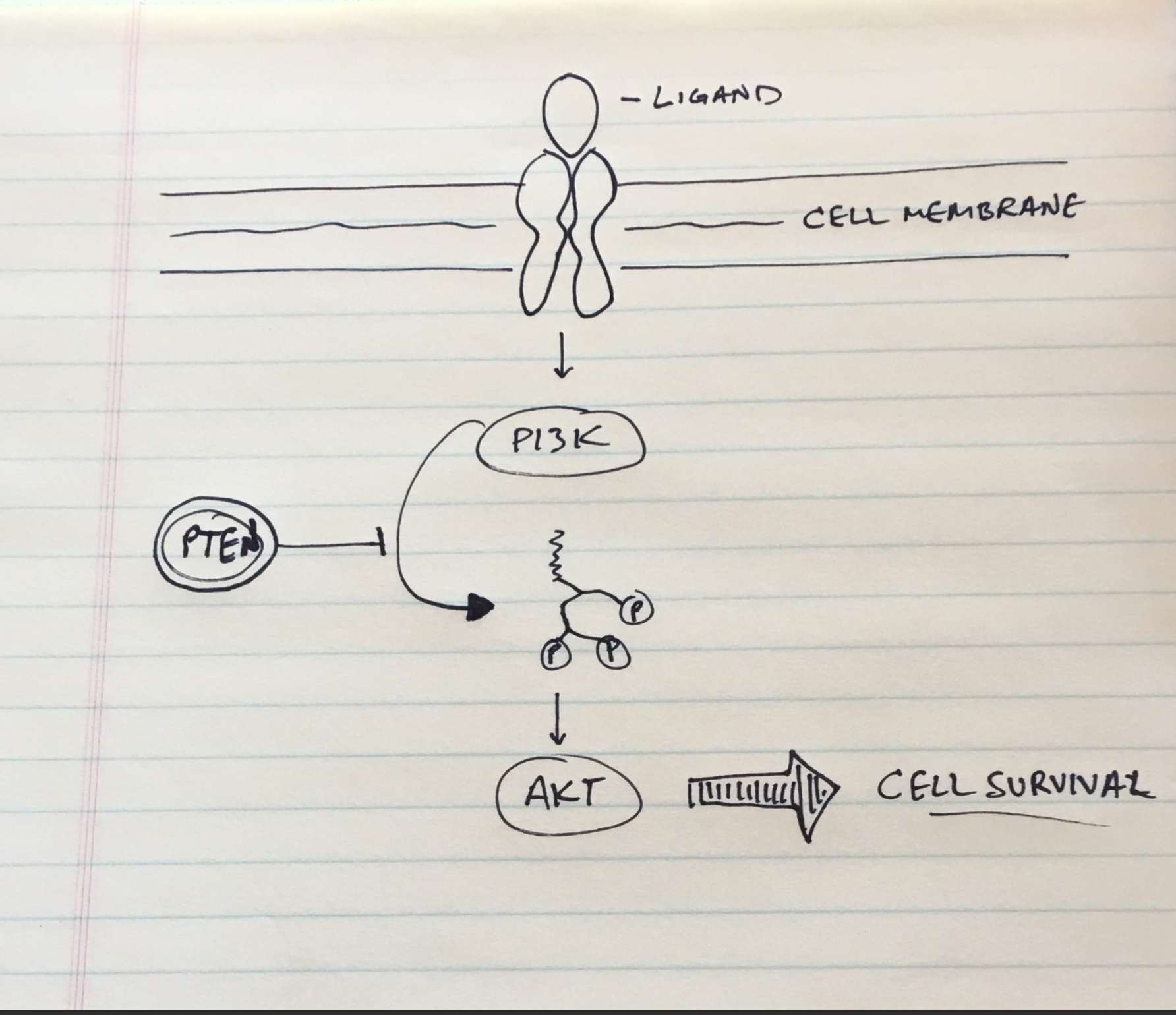
There’s the connection – the brains of patients with autism and those experiencing concussions are basically the opposite, in terms of axonal connections. Interesting, right? Well, recently, I’ve done research in the area of axonal sprouting and targeting the neurochemical pathway – PI3K-AKT – that is involved in autism. If this pathway is “turned on” too often, or not inhibited enough, autistic behaviors are observed in test subjects. However, a molecule responsible for inhibiting this pathway – phosphate and tensin homolog (PTEN) – is also an interest of mine in potentially treating brain injuries like concussions. If PTEN can be inhibited, the negative outcomes of a concussion can be better controlled. Below is a simplified schematic outlining this idea.
Screen Shot 2016-04-30 at 9.19.56 AM
Following binding of a ligand to the tyrosine kinase receptor on the membrane of the cell, PTEN inhibits PI3K signaling by dephosphorylating the lipid signaling intermediate PIP(3), which is a necessary factor in the communication between PI3K and AKT. This dephosphorylation prevents the pathway from promoting cell survival and inhibiting apoptosis, or programmed cell death.
However, if PTEN is inhibited, PI3K-AKT is turned on even more, which will lead to more axonal sprouting and more networking. So, would this PTEN inhibition lead to autistic behaviors, then? Or would a potential treatment for concussion lead to promising results with little drawbacks? That’s a question that has yet to be answered. But, like many areas of neuroscience, it interests me significantly. Obviously this idea that autism and concussions are somehow related is very broad and not understood well, but nonetheless, I believe it deserves some attention.
 

Thoughtful and Informed Citizens

“The purpose of Concordia College is to influence the affairs of the world by sending into society thoughtful and informed men and women dedicated to the Christian life.”
Engraved in the stone at the center of campus, these words could not be more true of Concordia College. The overly theme of my Concordia experience has always been service and contribution to the larger society. While at times campus has felt small, since the day I stepped on campus, it has been the goal of my professors, coaches, and mentors that when I step off of this campus I am equipped with the necessary tools to positively influence the world around me. This goal is carried out and proven by courses such as Neurochemistry.
Rather than sitting in a classroom listening to a professor describe, in detail, the neurological pathways of various diseases, this class challenged me to read, research, comprehend, and communicate the finding of empirical articles. Because of this, I was more invested in my own learning. It also taught me how to be engaged in a scientific society outside of the classroom. As an undergraduate, it can be difficult sometimes to remember science is an ever changing field with new discoveries occurring everyday. Because of this, I came to realize that the field of science is much more than just facts and information, but rather it is a field of discovery and curiosity.
In order to be an effective and and successful learner the most important trait to possess is curiosity. Curiosity is what sparks the human interest to discover. This is what has driven the field of study in neuroscience and it is what has driven our educational system. Neurochemistry has taught me how to harness my inquisitiveness and dig deeper into the available resources to find answers or find the real question I am asking.
The other essential aspect of learning that neurochemistry has taught me is that learning can be about formulating questions rather than finding answers. Throughout school, the goal of classes has been to find the correct answers to questions. However, this semester it was our job to ask questions. I found this to actually be more challenging for the same reasons as described above. We were responsible for figuring out what we wanted to learn rather than being told what we were supposed to learn. This is the cornerstone of being social active in society.
Individuals that greatly impact the world in a positive light do not sit around waiting for someone else to make a change. Instead, they are at the head of the pack leading the charge. They have the ability to formulate their own ideas and opinions and communicate them in an affective manner. This is what it means to be a Cobber.
As I leave this place for the last time, I take with me countless memories, friends, and life lessons. Why most students discuss the former, I believe that it is the later that will propel my career and life to a vocational calling. Throughout my Concordia College career and especially during my final semester, I have learned to learn, how to be responsibly engaged in the world around me, how to effectively communicate my thoughts and opinions in a professional manner, how to be curious, and how to see the bigger picture. Education is the culmination of all of the topics and experiences one has throughout school, not just the individual tests and classes one takes. This semester of Neurochemistry has taught me to think in a way that draws upon all of my knowledge rather than isolated topics.

My Concordia College Capstone Experience

When I first came to college I was under the impression that college was simply a means to an end. My end goal was med school and I was going to use Concordia’s stellar track record to help me get there.  I soon learned that medicine was not want I wanted to go into but rather field biology of some sort, even so Concordia was still a means to an end. It took quite a bit longer to realize that Concordia College (CC) was much more than simply a means to an end but rather a life changing experience that will forever change how I look at and approach the problems of this crazy world we live in.
Just about every class I took during my time here at CC came with a free soapbox from the professor about the problems of this world and how the class material was going to help us fix these problems. For at least my first two years this was actually quite annoying all I wanted was the material that I need to know to well on the next test not some problem with water usage in sub-Saharan Africa. However as I began to realize that CC was so much more than just a means to end I also began to listen to these passionate rants and really begin to appreciate the way each professor looks at the world and the problems within it. You see I believe it takes a certain kind of person to be a professor at a place like CC, a liberal art college. This type of person is not only very knowledgeable in their respective fields but is also very passionate about teaching students what it is all about. Another characteristic of CC profs is their inherent want/need to show students what we can do with this newly acquired knowledge and how we can use it help attack this worlds problems. I honestly believe that if my professors were not like this I would see the world a little differently.
I just finished my capstone course at CC. In order to graduate every student must take a  capstone course that’s goal is to link what we learn in the classroom to the outside world. The capstone class I took was called Neurochemistry and it was loads of fun. It makes sense to have this class be one of the last classes you take at CC because if I would have been a freshman I would have had problems understanding the rationale behind many of the assignments in the class. To put it basically we studied the chemistry of the brain and many brain related disorders in this class. On top of that (the most important part) we took the knowledge we learned about Schizophrenia, Autism, Alzheimers, etc. and thought “Okay we know this about it…what should we do know?” After spending two class days learning about each disorder we had class long discussions about how should society deal with this. You see I had actually been training for this class my entire college career. Like I said almost every class I took I heard about the problems in this world related to that topic. The thing that really set Neurochemistry apart from the other classes is what  I am doing right now: Blogging. Talking about the problems of our world is one thing but actually doing something about it is another. I understand that blogging is not going to fix our worlds problems but it is a start. In this capstone course I got my first wack at actually taking a problem I learned about in class and bringing it to the outside world. Blogging I think is a great way to help people understand the problems associated with certain mental disorders as simply educating the public about a number of them can do a lot of good for people with and family members of people suffering from mental disorders.
I got many things out of this class but what I really will never forget is how hard it is to take something filled with scientific jargon and put it into words that the public can understand. I will take this knowledge with me and work hard to show the public how much good science can do in our world!

My Capstone Experience at Concordia College

As apart of my capstone class at Concordia College, I took the course Neurochemistry. The class was filled with 14 seniors, from a range of backgrounds, and from a range of course experiences (mostly Chemistry, Biology, Neuroscience and Psychology). We delved into a VERY interesting field, and one emerging further into science every year. We reviewed current literature on the neurological mechanisms of numerous mental disorders such as Alzheimer’s, Parkinson’s, and Autism, but also looked into the neural implications with conditions such as Obesity and Diabetes. It was challenging and fascinating, something I have found to be a core principle with coursework at Concordia College.
As apart of engaging with the community, each student wrote a blog on what they found significant in each neurological condition. It was fun and fulfilling to educate the community on sometimes contentious issues such as endocannabinoids or alcohol addiction. There are a complexity of neuronal mechanisms happening in each psychological condition, and the general community often is very unaware this. The understanding of things like alcohol’s affect on the brain is often over-simplified. Substances like these affect each structure of the brain in a unique way, and can have various long-lasting effects on neuronal signaling for a lifetime. Through education and communication throughout the community, understanding of such drugs and conditions can become common knowledge! Overall, being involved with the off-campus community was an enriching experience, and something Concordia College values throughout their teaching.
Learning into neurochemistry and how these things affect real life conditions was very rewarding. Each student, with his or her academic and experiential background contributed to how these conditions are approached both scientifically and from a social perspective. On a liberal arts campus, each student has a very unique perspective to which they approach each condition or situation. More than half of the students in our senior capstone had studied abroad, which contributed to the diversity of ideas in our discussions. We even had an international student in the class which further helped add multiple viewpoints. In our discussions, we often confronted the heavy social issues that surrounded each psychological disorder, which was very engaging. With backgrounds in numerous parts of life and academic focus, our group worked successfully to have a thorough understanding of each condition, which reflects fundamental pillars of liberal arts learning!
By taking classes through multiple departments at Concordia, students often find topics they become very interested in. In addition by taking classes from a wide variety of fields, Concordia College grows a culture of loving to learn.   I have certainly grown to appreciate an education and passion for learning while at Concordia. I have added a major and minor to my original plan. Growing a culture of open-mindedness and learning is what Concordia College is all about, and these principles can be directly applied to issues throughout the world!
Overall, Concordia College is a rigorous but amazing school that prepares people to think critically on whatever task they come across in life! With such a globally conscious foundation on campus, accompanied by excellent academics throughout the science and humanities departments, Concordia College gives you the tools to succeed and be well aware of multiple perspectives from various aspects of education.

The importance of liberal arts education

As my time at Concordia comes to a close, I can’t help but reflect on the past four years and be truly grateful for the experience I have had. I became a part of a family like no other where talking about corn was “cool” and knowing people around every corner you turned was the norm. I had the ability to become close with my professors and build life long relationships.
Looking at neurochemistry as my capstone course, I have learned in a new way that I hadn’t experienced until this class. This course opened my eyes even more than they already were to the equality between students and professors. I was able to fully apply what I learned in this course to my outside relationships and life as a whole. My friends and family found it very interesting when I would come back from class every day and describe various neurological disorders and their causes because the information was so applicable.
I truly believe my education at Concordia has fully provided me with a fantastic liberal arts education and that “BREW” (Becoming Responsibly Engaged in the World) has been instilled in me.
The five goals of liberal arts learning at Concordia are: 1. Instill a love for learning 2. Develop foundational skills and transferable intellectual capacities 3. Develop an understanding of disciplinary, interdisciplinary, and intercultural perspectives and their connections 4. Cultivate an examined cultural, ethical, physical and spiritual self-understanding 5. Encourage responsible participation in the world
Neurochemistry has fully enveloped each of these five goals.
Every class period, as I mentioned previously, I would immediately tell a friend or family member about what I had learned and constantly desired to know more and gain a better understanding of each topic. Another aspect of this course I enjoyed was being able to apply what I had learned in neurochemistry to the anatomy course to accumulate more understanding and hear about other factors that were not discussed in the other course. As a whole, it allowed me to put the puzzle pieces together and make connections to obtain more knowledge on the subject area.
If I had the choice to do college all over, there isn’t anything I would change about it. Now that I am wanting to move onto dental school, I believe that I have an advantage by having the cultural awareness and the course work from every major. These classes have enhanced my learning by broadening my knowledge, thinking in different ways, and above all, finding an appreciation for every individual’s talents and not putting a hierarchy on anyone. But most importantly, I have learned how to become responsibly engaged in the world, not because thats what I’ve been told to do, but rather, because it is what I want to do.

Hats off to You, Neurochem!

Concordia College’s capstone Neurochemistry class taught by Dr. Julie Mach is the apex of a liberal arts education for a science major. It is both a class that pushes students outside of their comfort zone and a class that warrants great fun to be had. In this class, myself, my thirteen classmates, and Dr. Mach explored research about the brain’s mechanisms in disorders including obesity, Alzheimer’s, bulimia, Parkinson’s, schizophrenia, autism, and concussions. The structure of this class was far from a traditional lecture/assessment setting and unlike anything I have ever experienced before. Basically, an outsider could call us some brain nerds reading papers written by brain nerds with their PhD’s. In order to express my love for the class and reflect on how the class changed me as a student. I’ll explain an average week in the course.

Monday:

For me, Mondays were the most difficult day by far. The mission of the previous weekend was to read and analyze a 8-25 page paper on that week’s neurological topic. This sounds simple enough, right? Wrong. These papers were dense and complex yet often revolutionary. I would come to class feeling like I was completely lost in the paper yet in the back of my head had a feeling that these findings have huge implications in the science, medical, and social words. When we met as a class, we would spend the day discussing what we felt was important in the paper. What I loved about Monday’s was that we all were in the same boat: lost and looking for answers. We had the opportunity to sit in a circle, share our interpretations, and extrapolate the key concepts on the papers. As the day ended, we narrowed down our focus to 14 topics that we wanted to further research because we felt that they were critical in our understanding of the paper. Usually, as a type-A science major, the lack of understanding that accompanied Monday’s would send me into a panic. For this class, Monday’s were calming because I knew that this lack of understanding was a place to grow and that Dr. Mach would guide us in the right direction.

Wednesday:

Wednesdays were a day for everyone to live in the limelight. Between Monday and Wednesday, we all would research one specific topic related to the paper we are focusing on for the week and Dr. Mach would arrange “speed dating”. During speed dating, we would get four minutes with each other student were we could share what we personally researched to strengthen the entire class’s understanding on the neurological disorder. By the end, we had learned 14 new pieces of information related to the neurochemistry behind the diseases. No matter a person’s background or personality, everyone could positively contribute to the conversations.  I always left Wednesday feeling full of knowledge and an understanding of the research I had feared just two days before.

Friday:

Fridays in Neurochemistry were my favorite days of the class. We would move across campus to some comfy chairs and discuss. Rather than discussing purely the science behind these neurological disorders, we had the reign to discuss every aspect of them. This includes treatments, ethics, and social factors. It’s easy to be scientists studying the brain and what’s malfunctioning in it. But to truly help the population, I think it’s extremely important to examine the entire person and the life that they live. On Fridays, we spent hours having meaningful and deep conversations about neurological disorders that affect millions of people each year. Even if we disagreed on a topic, the atmosphere of the class was one that encouraged resolution of conflict and understanding. My favorite time of my school weeks were Friday afternoons where I could curl up in a chair with a cup of coffee and learn from my brilliant classmates and hear their opinions.
 
One would think that lecture style classrooms would be the most effective when learning about something as objective as the brain. After taking this neurochemistry course, I would disagree. I learned more about the brain and its disorders in this class than my entire career as a Neurochemisty major at Concordia. I owe this to my professor and my classmates. Without Dr. Mach’s innovation and atypical approach to the class, I my mind would have been stuck in the walls of a PowerPoint lecture. Without my classmates, my own knowledge wouldn’t have been tested and I wouldn’t have gained knowledge from a wide range of experiences.
 
To Concordia, to Dr. Mach, to my classmates, I say thank you. Thank you for pushing my mental limits and thank you for all of the new knowledge on my favorite organ: the brain.

Don't Let FOMO Get The Best Of You

How to sum up my semester of Neurochemistry? I’m not exactly sure… There needs to be more research done… My understanding of it is…

This class was unlike any other that I’ve taken so far. Being a science major you mostly get to learn what other people have already discovered. Theories and laws that have been researched and proven for years. Even in lab I do experiments that I already know what I should be getting.

Neuroscience is a very new field. There is a lot of knowledge about it, but there is so much more that we don’t know. Many of the papers we read and theories we looked at were very recent. A lot of times we found ourselves at a roadblock where we really couldn’t find any more information because it wasn’t out there. There wasn’t enough research on the topic to solidify any facts. There could be a lot of theories or potential, but wasn’t proven yet.

That was another cool part of all the research that we did, we got to hypothesize our own ideas. We could look at a broad spectrum of possibilities and make our own connections. Were they always correct? Maybe not. The words, “My understanding” or “I think” were never frowned upon in this class, they were encouraged. If the best scientists in the world couldn’t figure it out exactly, then why couldn’t we at least take a stab at it?

If you read a lot of articles in science you know how difficult it is to follow sometimes. There are a lot of acronyms and a lot of words that you don’t really know. There were many times I would read a paragraph, stop to think about it, and have no idea what I just read. Even walking into class I’d have paragraphs highlighted with things I didn’t understand. I became so thankful for the people in my class. 

I got to meet an almost entirely new group of people. At a small school like Concordia there isn’t a ton of opportunity to take classes with people who aren’t the same age other than the core credits. Neurochemistry is a capstone class that is taken senior year, considering I am at “senior status” even though I am a junior, I got to take a class with the people I normally just see around the science building.

There were so many different minds and personalities in our small, 14 person class. It was very interesting to hear other people’s perspectives, depending on how they grew up. Every Friday we discussed the issues surrounding our topic that week. For example, what is the cause of Alzheimer’s? Is there a better way to treat it? It seemed that every week it came back to the culture of the busy American’s.

 If only we would slow down, take some time to look around. This was something we all had in common. Being very driven, success seeking Cobbers we are pretty much always on the go. FOMO (Fear of Missing Out) is a real thing, fear of missing opportunities, fear of missing fun, and even fear of missing points. A lot of the damage came from oxidative stress. As we are always on the search for the next best thing, the next best cure, maybe it could all be solved by slowing down?

We talked a lot about death and sick people, but not in a sad way. We thought about spending more time with family and friends, making the years count instead of counting the years. As great as finding a cure would be all of us are a few years from being able to be the one who does that, so instead it was mostly about prevention and how to deal with the disease.

So what did I do in my semester of neurochemistry? I got a lot better at reading and communicating science. I figured out how to break down pictures and diagrams into an understandable way. I spent a lot of time listening and understanding other’s opinions. The most valuable lesson I learned from neurochemistry though didn’t have a lot to do with science. This course was rigorous and difficult, but take the time to slow down. The busy life style is a part of our culture and if you don’t keep up you might not make it, but it is important to make time for more than just work. It may save you in the end.

My Capstone Experience

Concordia College implements a capstone course into student’s coursework. It is stated to reinforce the connection between liberal learning and various academic disciplines. Neurochemistry was my capstone course, and I felt it met or exceeded all the exceptions to be called a capstone class.
Instill a love for learning
By taking neurochemistry, it has increased my interest in different areas of study. When I first signed up for the class, I thought it would be another class where the teacher teaches and the student take notes and listen. It was also interesting how it did not have a lab, since every chemistry course I took here had a lab with the lecture.
On day 1, my exceptions were completely thrown out. The class was orientated to helping each other learn. The beginning few weeks had students post on different synapse and signaling molecules. We each had to contribute something to our course wiki page. The fun part was when we got into reading different neurological disease. Mondays had us talk about the paper, and figure what we did not know for “speed dating” on Wednesdays. Friday had us just talk about anything related to the topic of the week. This classroom format was unique and installed a new way for me to learn.
The love of learning also comes from how each of us had to help one another to be able to succeed in this class. The collection of ideas from each other helped pushed thinking into a new aspect, in ways I would never have thought of.
Develop foundational skills and transferable intellectual capacities
Most articles we read each week was a hot topic in health. They included Alzheimer’s disease, Parkinson’s, autism, concussions, and obesity. All of these topics have real world application due to the increase of them in recent years. Concussions have become relevant due to Will Smith’s movie “Concussion” and how retired NFL stars have been seen with chronic traumatic encephalopathy (CTE). All of the topics were known previously before reading the articles, but the science behind how these topics were not uncovered until taking this class.
The knowledge we learned was also transferred to our weekly blog posts on the topic. We were able to condense the article and spread it to the public. Our public service announcement (PSA), also helped spread awareness of a hot topic of our choosing. Both activities helped reinforce our thinking and to be able to tell the public about it.
Develop an understanding of disciplinary, interdisciplinary and intercultural perspectives and their connections
Even though this class was a chemistry class, it was relatable to other disciplinary fields too. Some articles had biological pathways, psychology with animal studies, and English with the blogs. This class presented ideas from different fields in connection with chemistry. This class being neurochemistry was related to neuroscience as well. The study of the central nervous system was always relevant due to these diseases being in the brain.
 
Cultivate an examined cultural, ethical, physical and spiritual self-understanding
From taking this class, I learned how diverse chemistry can be. With the combination of different disciplinary fields in this course, I learned how they might be able to correlate together to find cures for different diseases. By understanding different pathways from articles in previous weeks, I was able to understand better how they relate to pathways in future articles. It showed me how my area of study could be used in different aspects of the learning.
 
Encourage responsible participation in the world (BREW)
By taking this class, it helped me think critically in other areas besides chemistry. I also learned how different areas of study can correlate with each other to do good. It made me think more critically about the topics we discussed. Marijuana, which is a schedule 1 drug, has shown to be effective in treating different diseases. The stigma of it still clouds people’s ideas on it.
This class has helped me engage with different aspects of studies, which I would have never known about, or would have thought about.


Spam prevention powered by Akismet