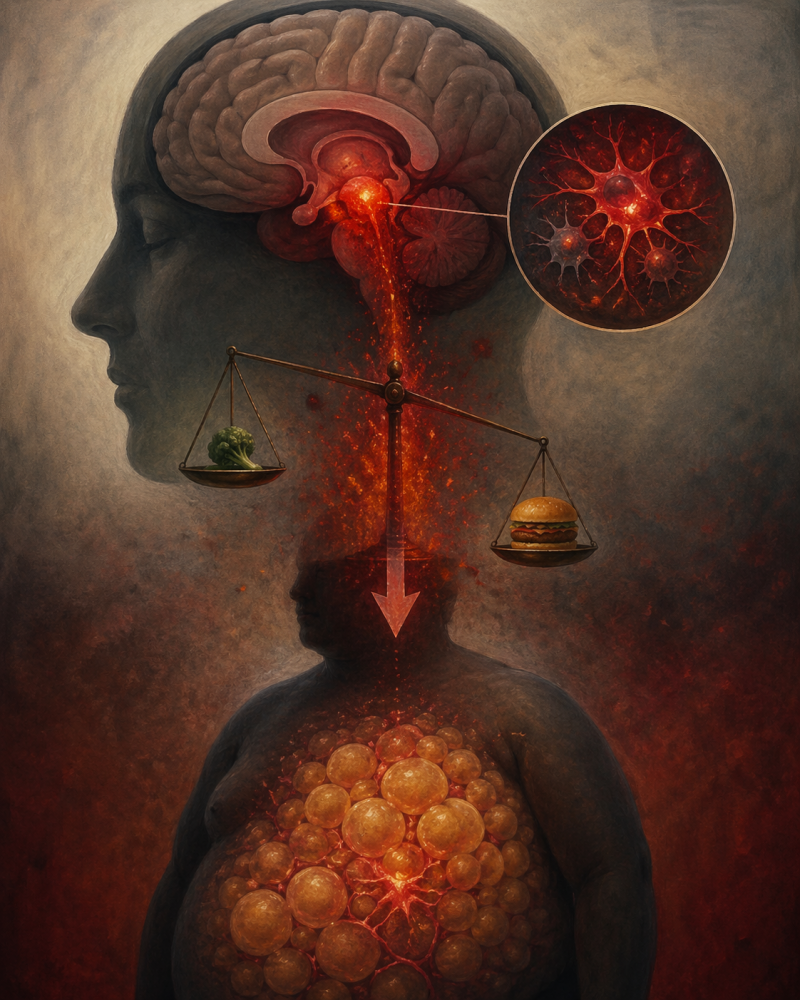
Artstract made by Eli Hunt with ChatGPT
If you were to ask people what they think causes obesity, many people would probably say it is a personal choice to eat that much, or that obese people don’t get enough physical activity. But what if I told you it was caused by the food we eat. The part of our brain that regulates hunger, the hypothalamus, can become inflamed by the food we eat. This leads it to have a hard time telling us when we are full or hungry. The foods associated with this are highly saturated fats, so by changing our diets we can help ourselves overcome or avoid obesity. Saturated fats are in many of the foods we eat and often foods we associate with obesity, to learn more about saturated fats and the foods that have them look here.
How Do High Fat Diets Cause Obesity
In the hypothalamus there are two classes of neurons that are associated with appetite. These are the AgRP neuron and the POMC neuron. When the AgRP neurons are activated, we seek out eating food and when POMC neurons are activated we do not. The way that we deactivate AgRP neurons is through leptin signaling. Leptin is a hormone released by our body when we are supposed to feel full. When saturated fats cross the blood brain barrier (BBB), they bind to receptors that activate signaling called TLR4. When this happens, it releases inflammatory cytokines around the hypothalamus, causing inflammation. When the hypothalamus is inflamed, it becomes more difficult for neurons around it to sense leptin, developing a sort of tolerance to leptin called leptin resistance. When leptin signaling cannot happen as efficiently, it becomes harder to inhibit AgRP neurons as effectively, and consequently we eat more food. This creates a dangerous cycle of eating high fat foods leading to the inflammation of the hypothalamus, and the inflammation of the hypothalamus causes us to eat more high fat foods which then cause more inflammation. This is why people with obesity eat copious amounts of food, it is not because they need to eat that much or that they ignore feelings of satiation, but it is because they simply do not feel full. To read more about the science of this process, read this article here.
What Can You Do?
The biggest thing you can do is avoid a high fat diet. In todays world, you have to be very intentional to look for this as it saturated fats are in much of the food we eat today. But this can only prevent obesity, but for someone who is already obese this can present a challenge.

Due to not feeling full, it can be difficult to stop eating if you are still hungry. But this period should be seen similarly to drug withdrawals. Your body is used to telling you you’re full after much more food than you need, so when you eat a normal amount of food, your body is telling you to keep eating. After a while though, as you lessen your leptin resistance, your body adapts to get full after eating that amount of food. The challenging part is eating that amount of food while your body is returning to this level and it takes high levels of discipline. In the modern world, it seems we are almost doomed to become obese. But being informed on what to avoid goes a long way, and having the discipline to avoid it does as well. It is important to keep in mind that saturated fats are sometimes unavoidable, and with anything in life, moderation is key. So if you want to go eat a bucket of fried chicken with some potatoes loaded up with butter, go and do that, just maybe not every day. The most important thing to remember with nutrition is that being fed is best, so if you cannot eat healthy it is better to eat unhealthy foods than not at all!
Sources
Images
British Heart Foundation. (2022). What foods add unhealthy fat?. British Heart Foundation. https://www.bhf.org.uk/informationsupport/heart-matters-magazine/nutrition/where-does-saturated-fat-come-from
ONIE Project. (n.d.). Making sense of nutrition labels. ONIE Project. https://onieproject.org/making-sense-of-nutrition-labels/
Information
Jais, A., & Brüning, J. C. (2017). Hypothalamic inflammation in obesity and metabolic disease. The Journal of clinical investigation, 127(1), 24–32. https://doi.org/10.1172/JCI88878
