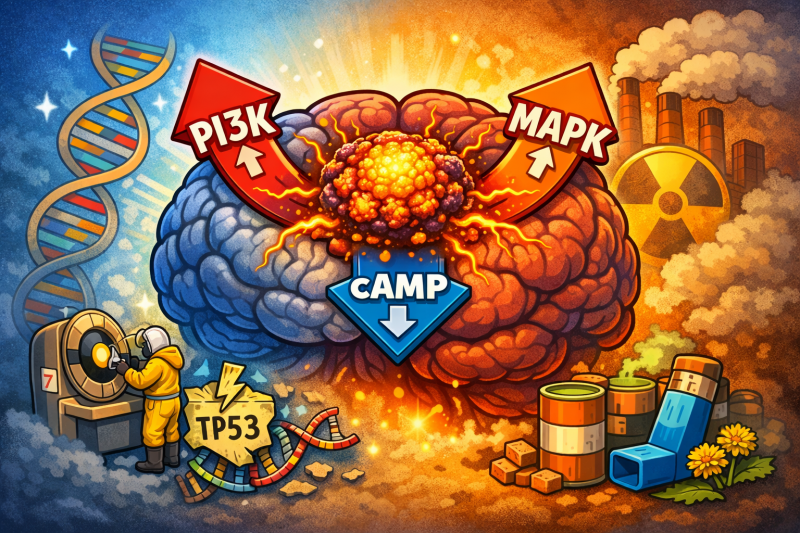
Can you image being told you have a brain tumor and that the median survival time is around 14 months. Unfortunately, that is the reality for patients diagnosed with Glioblastoma (GBM), the most common and deadly form of malignant brain cancer. And for many people, cancer feels like a random role rolling of dice. But researchers have been able to pinpoint some specific risk factors including genetic, environmental, and even immunology, that can help determine who is most vulnerable. Understanding these risk factors isn’t just fascinating science, it may get us one step closer, saving lives.
A brain tumor built from bad signals
A 2019 review discussed how GBM hijacks the body’s own cellular communication systems. Signaling pathways like PI3K, MAPK, and cAMP are responsible for telling our cells when to grow, divide, and die. However, in GBM, these first 2 are cranked up to full blast, while the third (cAMP, which suppresses tumors) is suspiciously quiet. This results in cells dividing out of control, invading neighboring brain tissue, and becoming almost impossible to treat.[1]
Who can get GBM?
GBM isn’t an equal-opportunity disease. Most diagnoses happen in adults between ages 45 and 70, with the average age at diagnosis hovering around 64.[2] Younger patients do get it, especially the “Proneural” subtype, which is discussed in the research as more common in younger individuals, however, it’s predominantly a disease of middle and older age. Sex also plays a role, as men are slightly more likely to develop GBM compared to women, though researchers are still trying to understand why. [3]
Environmental risks
The environment around us can quietly rewrite our DNA. The most known environmental risk factor for GBM ionizing radiation exposure. This is the same radiation that is sometimes used to treat other cancers.[4] Radiation can cause point mutations, DNA double-strand breaks, and chromosomal rearrangements in brain cells, potentially sparking the cascade that leads to GBM. Besides radiation, prolonged exposure to certain chemicals like pesticides, petroleum products, synthetic rubber, and vinyl chloride, has also been linked to elevated risk. These aren’t rare exposures; some people encounter them regularly in industrial or agricultural jobs.
It is not usually inherited, but sometimes it is
Most people don’t know that inherited glioblastoma is actually pretty rare. The vast majority of GBM- causing mutations happens suddenly during a person’s lifetime, not from one’s parents.[3] However, it is important to note that there is a handful of hereditary syndromes that drastically raise the odds including:
- Li-Fraumeni syndrome: involves inherited TP53 mutations, one of the most mutated genes in GBM tumors overall
- Neurofibromatosis type 1 (NF1): loss of this tumor suppressor is found in roughly 14% of all GBM cases, especially the mesenchymal subtype (as described in the article)
- Turcot syndrome: a mismatch repair disorder that predisposes people to both colorectal cancers and brain tumors including GBM
What is actually mutated in GBM tumors?
Top mutated genes in GBM
TP53- 34.4%
EGFR- 32.6%
PTEN- 32%
NF1- 13.7%
PIK3CA- 12%
The Cancer Genome Atlas (TCGA), a massive project cataloguing cancer-causing genomic alterations across thousands of patient tumors, has shown that GBM is essentially a disease of broken signaling.[5] The top mutated genes all tie directly back to the PI3K and MAPK pathways that the article described. This confirms that these signaling highways aren’t just academic curiosity, but the actual biological machinery that goes haywire in almost every GBM patient.
Could Asthma be Protecting you?
In what may be one of the most interesting findings, people with asthma and allergic conditions actually appear to have a lower risk of developing GBM. The immune activity associated with allergic responses may somehow create a microenvironment that’s hostile to tumor development.[2] This lines up with the broader picture in the review, which discusses how the tumor microenvironment and immune checkpoint pathways like PD-L1 are deeply intertwined with GBM progression.
Takeaway
GBM is not a simple disease with a single cause. Age, sex, radiation, chemical exposure, inherited syndromes, and spontaneous mutations in the wrong genes at the wrong time can all have a possibility of leading to glioblastoma. As the article remind us, once those PI3K and MAPK signals go haywire, they’re incredibly difficult to shut back down.
[1] N. H. Fung et al., “Understanding and exploiting cell signalling convergence nodes and pathway cross-talk in malignant brain cancer,” Cellular Signalling, vol. 57, pp. 2–9, May 2019, doi: 10.1016/j.cellsig.2019.01.011.
[2] A. F. Tamimi and M. Juweid, “Epidemiology and Outcome of Glioblastoma,” in Glioblastoma, S. De Vleeschouwer, Ed., Brisbane (AU): Codon Publications, 2017. Accessed: Apr. 30, 2026. [Online]. Available: http://www.ncbi.nlm.nih.gov/books/NBK470003/
[3] “Risk Factors and Symptoms of Glioblastoma – Brigham and Women’s Hospital.” Accessed: Apr. 30, 2026. [Online]. Available: https://www.brighamandwomens.org/cancer/glioblastoma/risk-factors-and-symptoms
[4] “Glioblastoma: GBM Symptoms, Causes and Survival Rate.” Accessed: Apr. 30, 2026. [Online]. Available: https://www.cityofhope.org/clinical-program/brain-tumors-cancers/types/glioblastoma
[5] P. Zhang, Q. Xia, L. Liu, S. Li, and L. Dong, “Current Opinion on Molecular Characterization for GBM Classification in Guiding Clinical Diagnosis, Prognosis, and Therapy,” Front. Mol. Biosci., vol. 7, Sep. 2020, doi: 10.3389/fmolb.2020.562798.
